
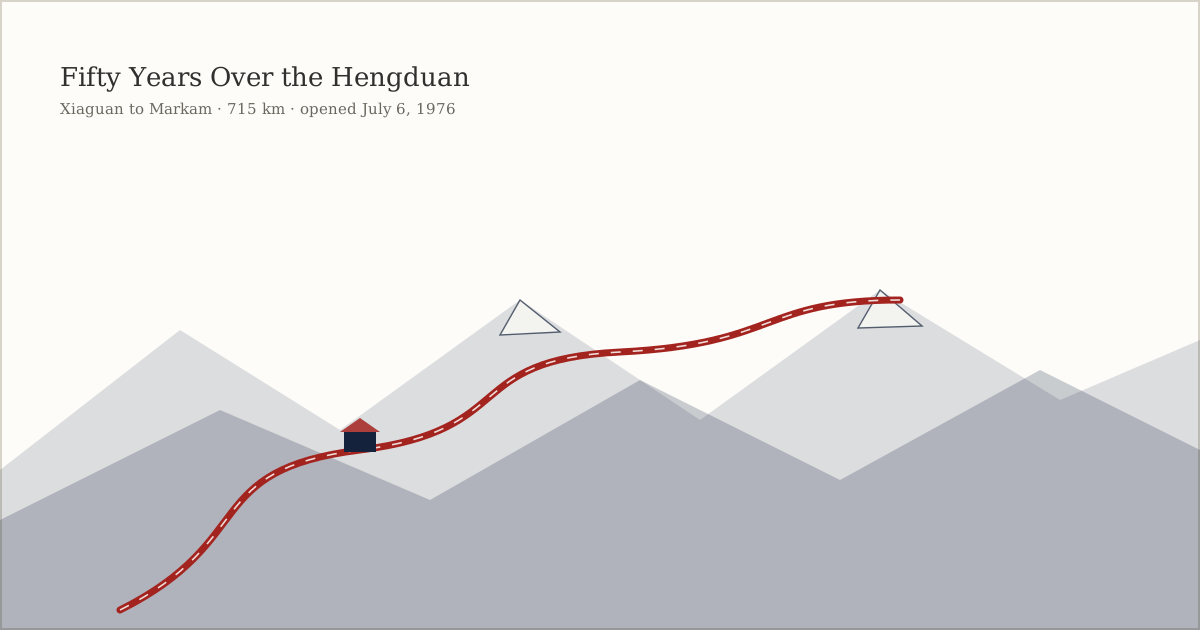
There is a coffee trade at altitude along the road from Yunnan into the Tibetan plateau—small roadside cafes and homestays serving beans grown in the province's warm southern valleys to travelers who have driven up into thin, cold air. It is an unlikely business to find on a Himalayan supply route, and it is a fair measure of how much the Yunnan-Xizang Highway has changed in fifty years.
The road opened to traffic on July 6, 1976. It runs 715 kilometers from Xiaguan, in the Dali region of Yunnan, to Markam county just across the boundary in the Xizang Autonomous Region, crossing two of Asia's great rivers—the Jinsha and the Lancang, the upper Yangtze and the upper Mekong—and threading the Hengduan Mountains, a range of parallel ridges and gorges that runs north to south and makes east-west travel genuinely difficult. When it was built, it was an artery of last resort: a way to move people and goods over country that had none.
Half a century of upgrades and repaving later, the highway carries a different cargo. State media marking the anniversary this month describe villages along the route that have turned to homestays, tourism and the coffee trade as the road shifted from a corridor people endured to one they travel for its own sake. The claims of local prosperity come from Chinese official coverage and should be read in that light. But the underlying change is not really in dispute: a road that once merely connected two points now supports an economy along its length.
That transition is the quiet story of a great deal of Chinese infrastructure. The dramatic version—the bridge that spans an impossible gorge, the rail line that reaches an unreachable town—gets the ribbon-cutting. The slower version is what happens in the decades after, when a route stops being remarkable and simply becomes the way things and people move, and a service economy grows up in the space the engineering opened.
Roads through high country are never finished in the way a building is. The Hengduan range still throws landslides and washouts at the highway every wet season, and the maintenance never stops. What has changed is who is inconvenienced when it closes: fifty years ago, a supply convoy; today, a family that has driven up for the passes and the coffee, and the homestay expecting them that night.