
For most of the last century, a foreign investor with a contract dispute in Tashkent had two unappealing options: an Uzbek court, or the long flight to an arbitration panel in Paris or London. President Shavkat Mirziyoyev's answer is to move a slice of London to Tashkent.
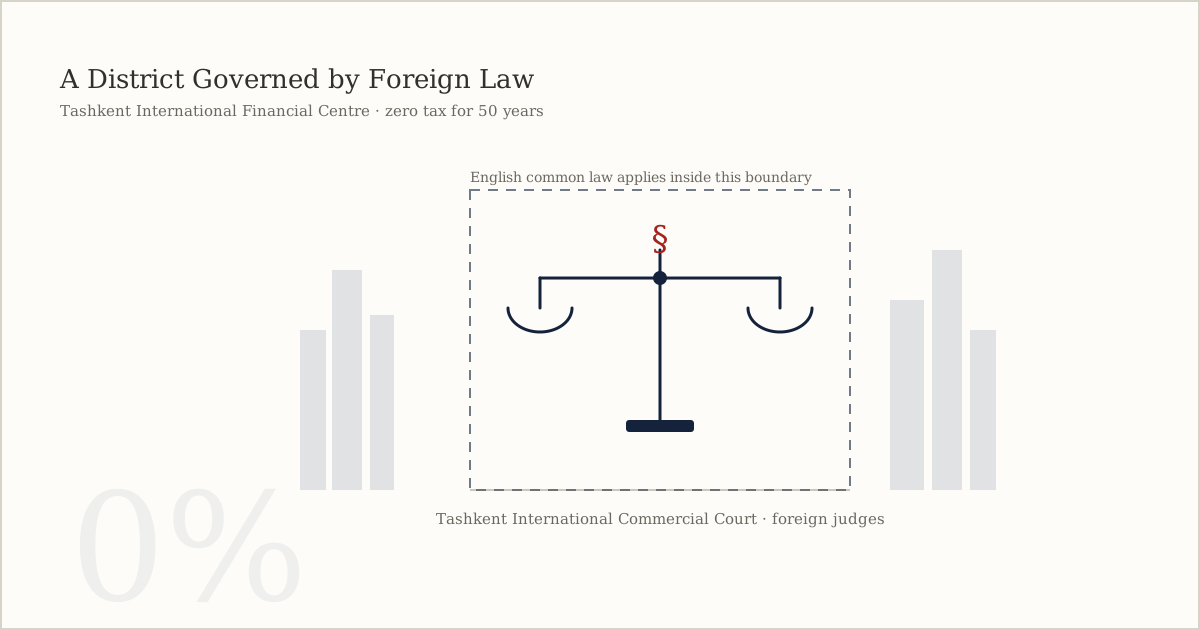
At the fifth Tashkent International Investment Forum in June 2026, Mirziyoyev unveiled the Tashkent International Financial Centre — a fenced legal and fiscal enclave that will run, within its own boundaries, on the common law of England and Wales. Inside it, profit tax, value-added tax (VAT), property tax and customs duties are to be set at zero for an initial fifty years. Capital may move freely and payments may be made in any currency. Commercial disputes will be heard not by Uzbek judges but by an independent Tashkent International Commercial Court staffed with foreign jurists.
The model is not original, and Uzbekistan is not pretending otherwise. It is borrowed, almost feature for feature, from the Dubai International Financial Centre (DIFC), Abu Dhabi Global Market (ADGM), and — closest to home — the Astana International Financial Centre (AIFC) that neighboring Kazakhstan opened in 2018. Each is the same idea: carve out a jurisdiction where English commercial law applies, import judges whose independence global investors already trust, and wait for the capital to follow.
The reform behind the enclave
Uzbekistan has more to prove than most, because a decade ago it was one of the most closed economies in Asia. Until the death of Islam Karimov in 2016, converting the Uzbek som at the official rate was a fiction and the black market did the real work. Mirziyoyev freed the currency in 2017, and the years since have brought a genuine opening: privatizations, a debut on the London market, foreign banks allowed in. A financial center governed by English law is the logical next chapter of that story — and also its most revealing test.
A special legal regime is a promise that inside these walls the rules are different. Investors will spend years watching to see whether the walls hold.
The question every prospective tenant will ask is not written in the enabling law. It is whether an independent commercial court can function inside a political system that remains tightly centralized. Uzbekistan holds no competitive national elections; constitutional changes in 2023 extended the president's potential tenure into the 2030s. The financial center asks investors to believe that the state can bind itself to neutral adjudication in one walled compound while retaining full control everywhere outside it. That is a coherent proposition — Dubai has run on exactly that split for two decades — but it is a proposition, not yet a record.
What the neighbors learned
The cautionary example is next door. Astana's AIFC opened with the same English-law promise and comparable fanfare, and its results have been modest: it drew listings and registrations, but it did not turn Almaty or Astana into a rival for Dubai or Singapore, and much of its early activity was regional rather than global. The lesson Tashkent's planners appear to have drawn is that the legal enclave is necessary but not sufficient. Zero tax and imported judges lower the cost of coming; they do not by themselves generate the deal flow, the depth of capital, or the cluster of law firms, auditors and bankers that make a financial center more than a registry.
Uzbekistan does have raw material that Astana lacked at launch: a domestic economy of some 37 million people, the largest population in Central Asia, growing quickly, with state assets in gold, uranium, aviation and banking still to be sold. The center is being pitched as the venue where those privatizations, plus fintech, digital assets and green finance, will be transacted under law that international counterparties recognize.
Whether that pitch works will not be settled by the opening ceremony. It will be settled the first time a foreign investor wins a judgment against a well-connected local counterparty in the Tashkent International Commercial Court, and the judgment is enforced. Until that day, the center is an architecture of intent — fifty years of zero tax, a borrowed body of law, and a wager that a country can quarantine the rule of law inside a single district and have the world treat it as real.