
For fifty years, the promise of Thailand's car industry was the supplier next door. Attract the global assemblers — Toyota, Honda, Nissan, Mazda — and around them would grow a dense web of local firms stamping panels, moulding bumpers, winding wiring. That ecosystem, more than any single factory, made Thailand the "Detroit of Asia." It is the part now at risk.
In May 2026, ten Thai automotive-industry groups issued a warning that the sector faced crisis and could fall off a "cliff" in 2027, when a government incentive scheme that required EV makers to produce locally is set to expire. Their complaint is not that the electric transition arrived. It is that the government's bet — luring BYD and other Chinese manufacturers with subsidies — is hollowing out the domestic supply chain it was supposed to modernize.
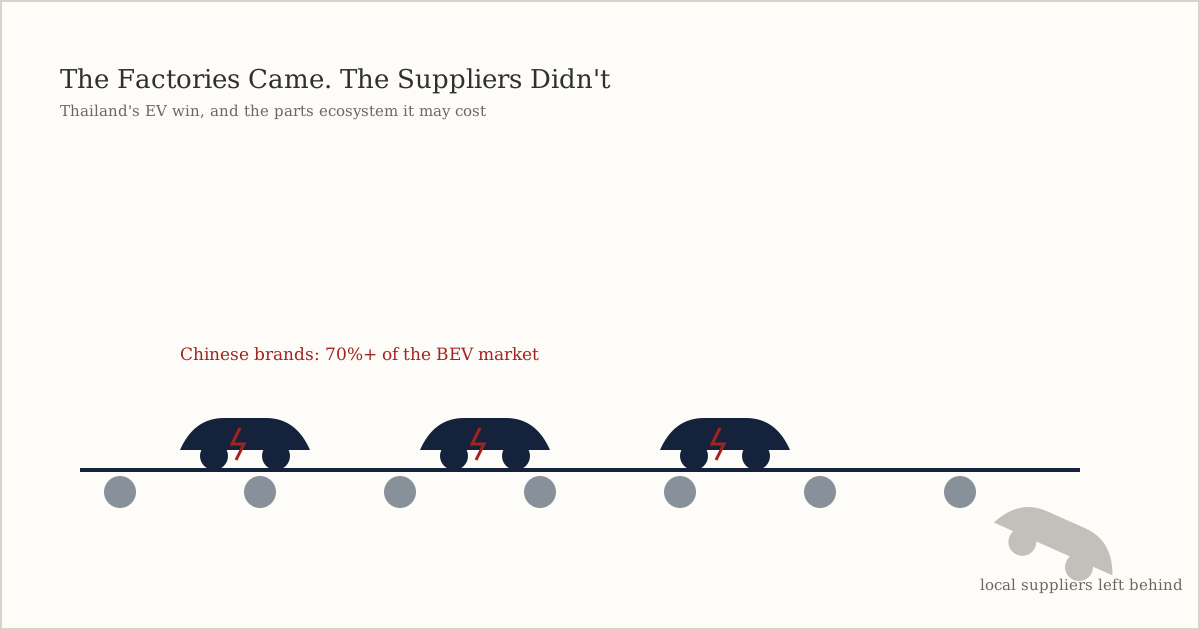
The pricing gap explains the alarm. Chinese electric vehicles undercut their Japanese and Korean rivals by anywhere from 7 percent to more than 50 percent, helped by tariff treatment that leaves Japanese EVs facing 20 percent import duties and Korean ones 40. Chinese brands now hold over 70 percent of Thailand's battery-electric market. A consumer buying the cheapest capable EV is, more often than not, buying one whose parts were made in China, not Chonburi.
The suppliers feel it first
The damage is already visible on the factory map. Subaru closed its Bangkok plant. Suzuki announced the shutdown of its Rayong facility. Honda halved production capacity; Nissan shuttered one of its two Thai factories. Total vehicle production fell roughly 20 percent in 2024 to about 1.5 million units, and output has kept sliding. The Federation of Thai Industries estimates that more than 100,000 auto workers face redundancy between 2025 and 2026.
A country can win the factories and still lose the industry, if the new plants import their parts and the old supplier base is left with nothing to make.
This is the distinction the celebratory version of the story misses. Landing a BYD plant is an industrial-policy trophy. But an assembly line that imports its components from its parent company's home country generates far less local value than the combustion-era supply chain it displaces. If Chinese manufacturers build in Thailand mainly to serve the Thai and regional market with China-made parts, the country becomes a distribution point, not a production base — and the thousands of small suppliers that defined the Detroit of Asia have no obvious role in the new arrangement.
What the industry is asking for
The response from Thai producers is protectionist and specific. The Electric Vehicle Association of Thailand and allied groups want the excise tax on fully imported EVs raised to at least 32 percent, local-content requirements tightened, import quotas tied to domestic production, and technology transfer written into the terms. Some associations have pushed for a 32 percent import duty on Chinese EVs outright. The aim is to force the value — the parts, the engineering, the jobs — to stay onshore rather than arrive in a shipping container.
The government is caught between two goods it promised at once: a fast, cheap electric transition for consumers, and the preservation of a manufacturing base that employs hundreds of thousands. Chinese EVs deliver the first. They are steadily undermining the second. Whether Bangkok tightens the rules before the 2027 cliff, and whether the Chinese manufacturers deepen their local roots or keep importing, will decide if Thailand ends the decade as an EV production power or as the region's showroom for cars built somewhere else.