
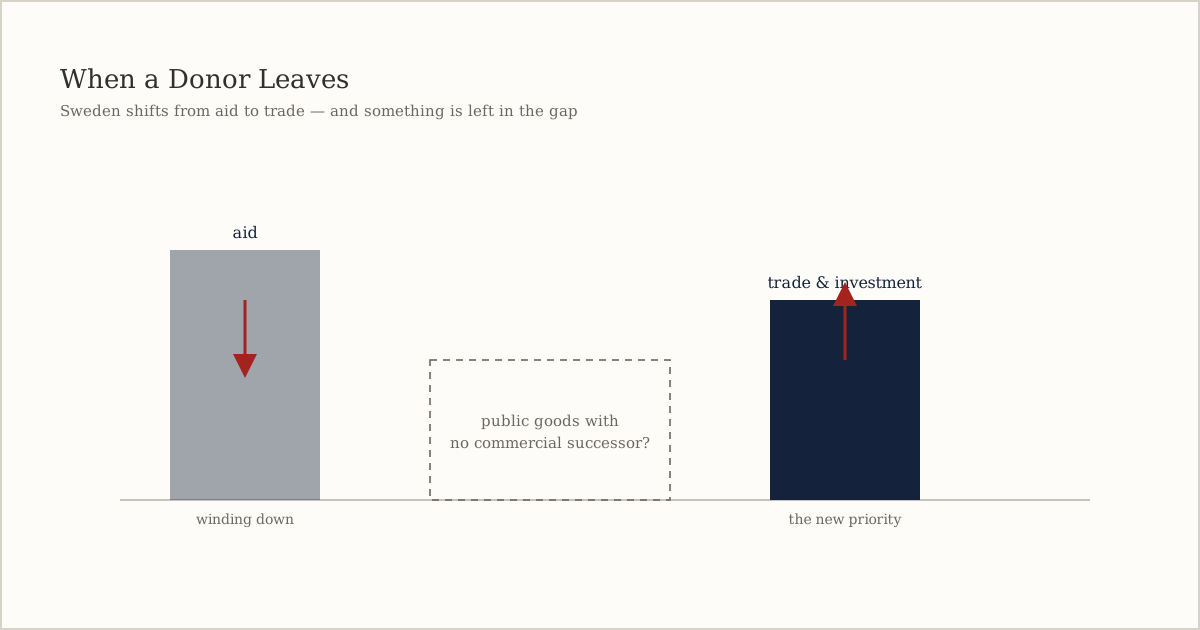
For decades Sweden was, per krona, one of the most generous donors on earth, routinely giving more than the United Nations target of 0.7 percent of national income. That era is closing. In 2024 its aid amounted to about 0.79 percent of gross national income, down from more than 1 percent in 2020, and the government has legislated further cuts, with the annual budget set to fall from 56 billion to 53 billion Swedish kronor over 2026 to 2028.
The shift is not only about money. In December 2023 the government published a reform agenda — "Development Assistance for a New Era" — that reweights Swedish policy toward job creation, trade and private investment, and explicitly links aid to the promotion of Swedish business. Cooperation with several partner countries in Asia and Africa is being wound down. Some long-standing arrangements with civil-society organizations were terminated outright, a decision that drew sharp criticism from Sweden's own NGO sector.
The rationale is coherent on its own terms. A government facing domestic fiscal pressure is entitled to reset its priorities, and the argument that trade and investment can do more for long-run growth than grants is a respectable one with a real evidence base. Sweden is not disappearing from the region; it has kept a contribution of up to 258 million kronor to the Asian Development Fund, which supports the poorest countries in Asia and the Pacific, and it frames the pivot as modernization rather than retreat.
The gap is the story
What a departing donor leaves behind is rarely captured in the budget line it cuts. Swedish aid has historically funded things the market does not: human-rights monitoring, women's and girls' programs, independent media, civil-society networks, environmental work. These are public goods with no obvious commercial successor. When the grant ends, a trade mission does not replace a women's-rights program, and a Swedish exporter does not pick up the running costs of a local watchdog.
The government says the new approach links development cooperation, promotion and trade to advance sustainable development and economic growth.
That is the substance worth following, country by country. Where Sweden funded a niche that others also support, the transition may be orderly. Where it was the main or sole backer — of a particular civil-society coalition, a specific environmental program, a press-freedom initiative — the wind-down leaves a hole, and the question is whether anyone fills it. Aid analysts have described the change as the possible end of a Swedish model, and the abrupt cancellation of NGO agreements suggests the transition has been managed more by fiscal calendar than by careful handover.
The reweighting toward trade also changes who benefits. Aid tied to Swedish commercial interests tends to flow where Swedish firms can sell, which is not necessarily where the need is greatest. That is not illegitimate — most donors are moving the same way — but it is a different objective than the one Swedish aid was built around, and it should be described as what it is rather than as continuity by other means. The countries losing Swedish programs are about to run the experiment the rest of the donor world is watching: what actually happens, on the ground, when a reliable funder decides it is time to go.