
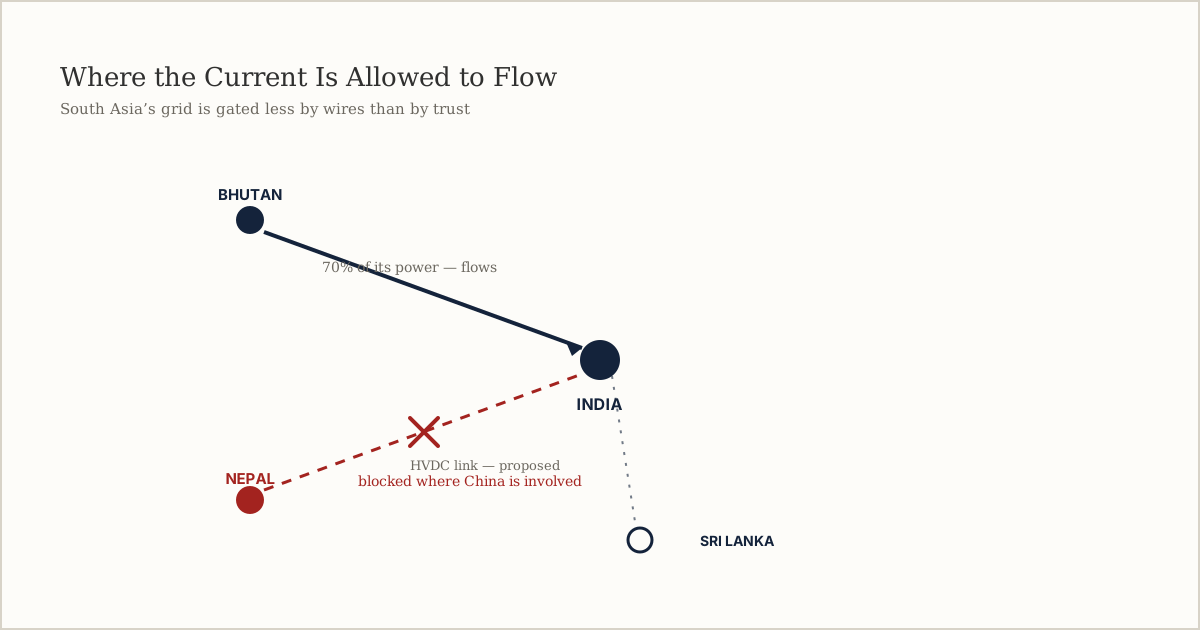
The 456-megawatt Upper Tamakoshi is the largest power plant Nepal has ever built, the one meant to prove the country could light its own homes and sell the surplus to its giant neighbor. It ran into an obstacle no turbine could fix. A Chinese company had helped build part of it, and under India’s rules that was enough to keep its electricity out of the Indian market.
The problem was never the physics. The lines exist; the current can flow. What could not flow was Indian permission. And that is the truest thing about electricity in South Asia: the grid’s hardest constraint is not engineering but trust, and trust in this region is distributed unevenly and, increasingly, along the fault line that runs between India and China.
The trade that works
Start with the case that functions. Bhutan sells roughly 70 percent of its hydropower to India, and those exports amounted to about 16 percent of Bhutan’s gross domestic product (GDP) in 2021. That is an extraordinary degree of dependence for a sovereign state to accept, and Bhutan accepts it because the relationship has been built, dam by dam, over half a century of Indian financing, Indian construction and Indian offtake. The electricity crosses the border because the political economy behind it crossed first.
The aggregate numbers are moving in the right direction. Cross-border electricity trade among the Bangladesh–Bhutan–India–Nepal (BBIN) countries nearly tripled, from 7.8 terawatt-hours in 2013 to 21 terawatt-hours in 2024. It still runs far below what the region’s geography could support, held back by thin transmission links, heavy capital costs and, above all, the political friction of deciding who may sell to whom. The wires are the cheap part.
Nepal’s electricity is priced not by the megawatt but by the passport of whoever helped build the plant.
The trade that doesn’t
Nepal should, on paper, be the region’s hydropower giant. Its economically viable potential is often put at around 42 gigawatts, against installed capacity of roughly 2,800 megawatts today — a gap that represents one of the largest untapped clean-energy resources in Asia. India has signed on to the ambition, agreeing in principle to a long-term arrangement to import up to 10,000 megawatts of Nepali power over the coming decade. Yet the same India gates that power at the source.
India’s 2018 Guidelines for the Import and Export of Cross-Border Electricity opened the door to freer regional trade. A subsequent procedure, issued in 2021 after the deadly 2020 clash between Indian and Chinese troops in the Galwan Valley, narrowed it again: Indian authorities have since made clear they will not buy electricity from Nepali projects that carry investment, equipment or contractors from Chinese firms not approved for the Indian market. Upper Tamakoshi was the demonstration case, but the chilling effect is broader. Nepali developers now weigh whether hiring a Chinese contractor, or taking Chinese equity, quietly forecloses their most valuable customer.
The result is a hydropower sector where the value of a plant depends less on its output than on the nationality of the money and machinery behind it. A megawatt built with Chinese involvement is worth less than an identical megawatt built without it, because only the second can be sold across the border at scale. That is not a pricing signal an engineer would recognize. It is a geopolitical one.
Two problems wearing one coat
Two problems usually travel together under one label, “the grid problem.” They are not the same. One is genuinely technical: balancing supply and demand across a system fed by monsoon-dependent hydropower, with too few interconnections and pricing still negotiated bilaterally rather than cleared through a regional exchange, the way Europe or the Association of Southeast Asian Nations (ASEAN) power pool aspire to do. That problem yields to batteries, transmission lines and market design.
The other problem is about sovereignty and suspicion, and it does not yield to hardware at all. Deciding whose power a country will accept onto its grid is a question about dependence and leverage — who could switch off the lights, and what they might ask for in return. Conflating the two makes both look intractable. Kept separate, the technical one looks solvable and the political one looks like what it is: a choice, revisited whenever relations shift.
The model travels — as far as trust does
The template that works can be exported, but only where the trust travels with it. In April 2025, during Prime Minister Narendra Modi’s visit to Colombo, India and Sri Lanka signed a memorandum of understanding for a high-voltage direct-current (HVDC) link across the Palk Strait, connecting Madurai in southern India to Sri Lanka’s grid. The roughly ₹9,900 crore ($1.2 billion) interconnector, to be built by the Power Grid Corporation of India and the Ceylon Electricity Board, would run about 285 kilometers, including 50 kilometers of submarine cable, and enable power to flow both ways.
That is a different animal from a fiber cable or a toll road: a state-to-state power project, financed and owned by public utilities, with a capital cost and a lead time that only governments absorb. It advances because Colombo and New Delhi have decided the interdependence is worth it — the same calculation Bhutan made decades ago, and the one Nepal keeps running into the China clause of. The interconnector is a bet that a physical link can deepen a political relationship. It can. It cannot create one that isn’t there.
For the small hydropower states, the lesson is not the one the wiring diagrams suggest. Nepal will not unlock its 42 gigawatts by building more lines to India; it will unlock them by resolving, one way or another, whether it can develop that potential without the Chinese capital and contractors that Indian policy penalizes — and whether India will keep paying the price, in forgone clean energy, of insisting that it does. Bhutan’s success was never really about the dams. It was about the decades of trust that made the dams financeable. That is the part no one has yet worked out how to build on demand.