
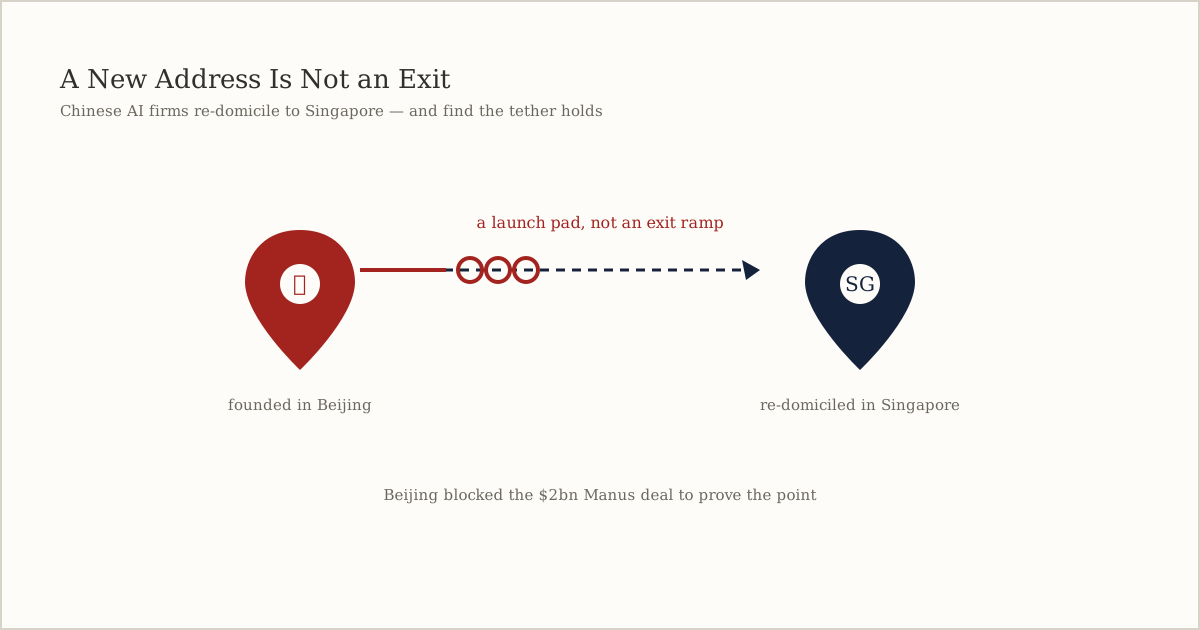
The practice even had a nickname before it had a limit. Since October 2024, when the United States barred American funds from investing in China's artificial-intelligence sector, Chinese startups found a workaround: re-domicile in Singapore, raise the capital and reach the customers that a Beijing address had closed off. Investors and founders called it "Singapore washing." In 2026 they learned it does not clean as much as they thought.
The test case was Manus, an AI-agent company founded in Beijing that moved its headquarters to Singapore in mid-2025 and, by December, had agreed to be acquired by Meta for around $2 billion. On paper it was a Singaporean firm selling to an American one. Beijing disagreed. China's National Development and Reform Commission moved to review and ultimately unwind the deal; by late March the co-founders, Xiao Hong and Ji Yichao, had been barred from leaving China while regulators examined the transaction, and by the end of April the acquisition was dead.
The message was deliberate. A Chinese-founded company cannot re-incorporate its way out of Chinese jurisdiction while its core technology and its key people remain inside China. Singapore, in the phrase that circulated after the ruling, can be a launch pad but not an exit ramp.
What makes a company Singaporean
The episode exposes how thin the relocations often are. Moving a headquarters is a filing. The engineers, the training data, the model weights and the founders frequently stay in China, which is where the actual work happens. A company can hold a Singapore address, a Singapore bank account and a Singapore logo while its center of gravity never leaves the mainland. Beijing has now asserted that the center of gravity is what counts — and it has the leverage over people and assets at home to enforce that view.
A headquarters is a filing. Where the model is trained, and where the people who train it can legally travel, is the harder fact.
Washington is asking a version of the same question from the other side. US export controls turn on whether a firm is genuinely severed from Chinese control, and enforcement actions in 2025 and 2026 targeted entities linked to Singapore and Malaysia for allegedly diverting restricted Nvidia chips into China. Singapore incorporation does not settle whether a company gets access to advanced American semiconductors; regulators on both sides are looking past the paperwork to the operational reality underneath.
The city caught in the middle
Singapore did not seek this role, and it is an uncomfortable one. Its appeal has always been neutrality — a trusted, rule-bound base where capital from everywhere feels safe. The AI decoupling turns that neutrality into a liability, because a genuinely neutral hub is exactly where each side suspects the other of laundering advantage. The more Chinese firms use Singapore as a bridge to Western money and Western chips, the more pressure Washington puts on Singapore to police them, and the more Beijing signals that it can reach back across the border to reclaim what it considers its own.
The Manus case did not end the migration; founders and investors are still weighing the move, and Singapore still offers things neither Beijing nor a blacklist can. But it redrew the terms. A relocation now buys less than it did a year ago, because both governments have decided that a company's nationality is a matter of where its technology and talent actually sit — not where it says it does. For a small state that sells trust for a living, being the ground two superpowers fight over is a harder business than being the neutral option ever was.