
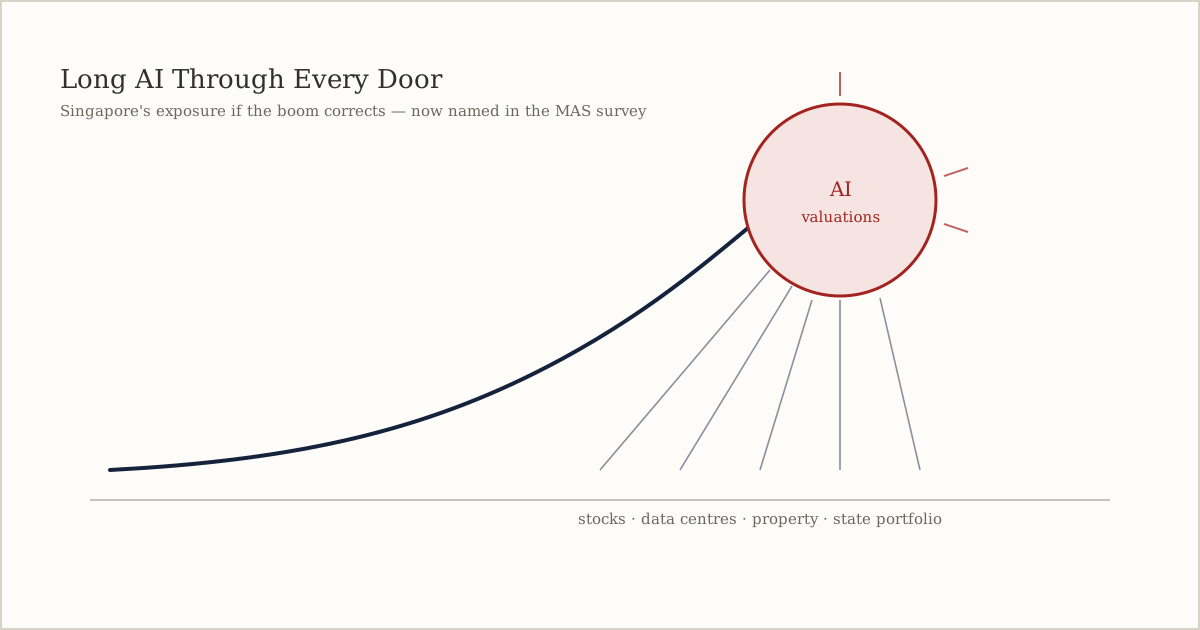
When the people paid to be optimistic start naming the risk, it is worth reading the footnotes. In the Monetary Authority of Singapore's June 2026 quarterly survey of professional forecasters, 15 percent of respondents flagged the bursting of the AI bubble as a downside risk to the economy — a new theme, sitting alongside Middle East conflict on the list of things that could go wrong.
That matters more in Singapore than almost anywhere, because the city-state has arranged much of its recent prosperity around the same bet. The economy grew strongly on AI-related demand; exports of the electronics that feed data centers surged; the property and power markets bent to accommodate server halls. And Temasek, the state investment company whose returns underwrite part of the national budget, has said it intends to lift its AI-related holdings from around 6 percent of its portfolio toward 15 percent within a few years — even as it acknowledges that some AI valuations have run ahead of the businesses beneath them.
Stack those exposures and a single question emerges: what does a correction do to a country that is long AI through this many channels at once?
The exposures compound
The vulnerability is not one bet but several, layered. Technology equities held directly and through funds. Venture capital deployed into AI startups. Data centers built on long electricity contracts and scarce land. Commercial property leased to tech tenants. The state investor's rising allocation. High-skilled employment tied to the sector. In a diversified economy any one of these could wobble without much consequence. In Singapore they are correlated — a genuine AI downturn would hit the stock holdings, the venture book, the data-center demand, the property leases and the state portfolio in the same quarter, because they are all responses to the same underlying boom.
A diversified portfolio of bets on the same trend is not diversified. It is one bet, wearing six coats.
Enterprise Singapore has itself listed a correction in AI-related investment demand among the risks to export growth, even while that demand remains the thing propelling it. That is the awkward position of an economy riding a wave it cannot control: the same force delivering record growth is the one whose reversal it most fears, and the timing of the reversal sits with American hyperscalers' capital-expenditure decisions, not with anything Singapore does.
Why the warning is useful
None of this means the boom is about to break. AI demand may keep compounding for years, and Singapore has navigated cycles before by being nimble where larger economies are not. The value of the central-bank survey is that it puts a number on a risk that promotional coverage tends to leave out — a reminder that a city-state cannot hedge a global bubble by being well-run, only cushion it.
The honest reckoning is about magnitude. If AI is a durable productivity shift, Singapore has positioned itself early and will compound the advantage. If a meaningful share of current valuations is froth, the correction reaches Singapore through more doors than it reaches most places, and the state's own balance sheet is behind several of them. The MAS survey did not predict a crash. It did something more useful for a country this exposed: it wrote down, in the government's own numbers, how much is riding on the boom continuing.