
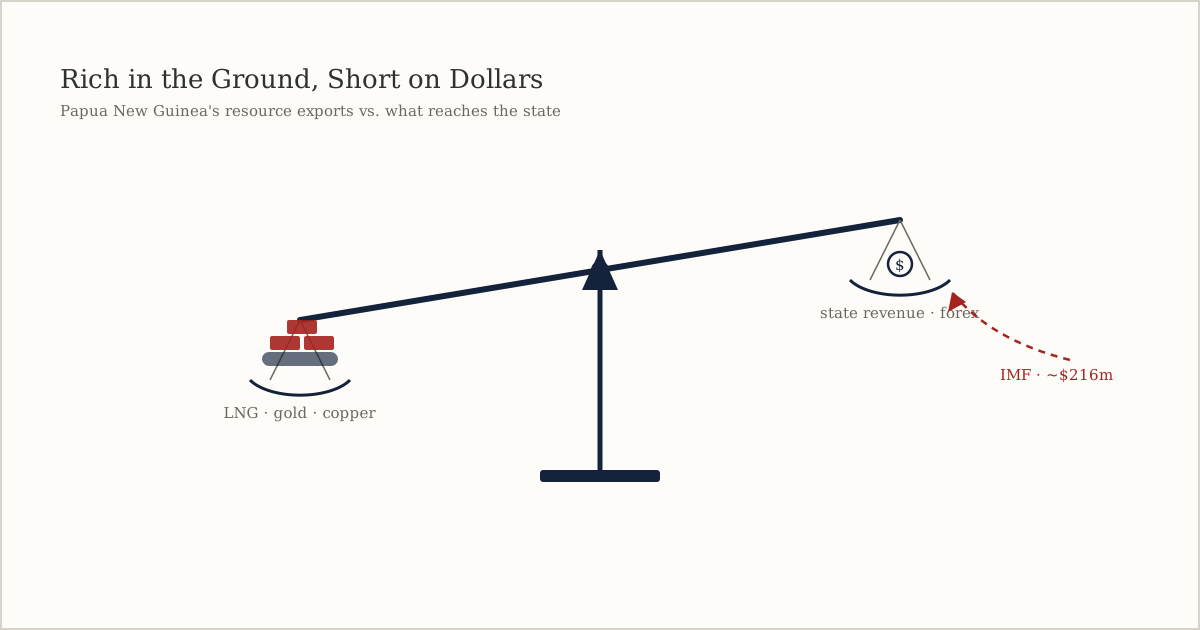
A business in Port Moresby that wants to pay an overseas supplier does not simply wire the money. It joins a queue. For years, importers in one of the most resource-rich countries in the Pacific have waited weeks or months for their banks to find the US dollars to settle ordinary invoices — a foreign-exchange backlog in a nation that exports some of the most sought-after commodities on earth.
That contradiction is what the International Monetary Fund's latest program is really about. On March 31, 2026, IMF staff and the Papua New Guinea authorities reached a staff-level agreement on the sixth reviews of the country's Extended Credit Facility (ECF) and Extended Fund Facility (EFF) arrangements, together with the third review of its Resilience and Sustainability Facility (RSF). Board approval would release about US$216 million — roughly US$82 million under the ECF and EFF, and up to US$134 million under the RSF — taking total disbursements under the current programs past US$1 billion.
Papua New Guinea is not broke in the way that phrase usually implies. It runs a liquefied natural gas (LNG) export project led by ExxonMobil, ships gold and copper, and has a second major gas development, Papua LNG, in the pipeline. The Fund projects growth easing to 3.8 percent in 2026 from an estimated 5.6 percent in 2025, as existing LNG output levels off and a turbulent Middle East raises the country's import bill. A slowdown, not a collapse. So why the queue for dollars, and why the Fund?
Extraction without conversion
The honest answer is that Papua New Guinea has never been good at turning what comes out of the ground into money the state can spend or citizens can use. Resource projects are built as enclaves. They import their equipment, employ a relatively small workforce, and route much of their revenue offshore through the financing and tax structures that made them possible in the first place. The gas flows to Asian buyers; a thinner stream flows back to the treasury than the headline export figures suggest.
The country's difficulty is not a lack of natural resources. It is the weak conversion of extraction into state capacity.
Follow the money and the leaks appear at every junction. Landowner royalties are disputed and delayed. Provincial governments receive a fraction of what the projects on their land generate. A sovereign wealth fund meant to bank the windfall was legislated years ago and has been slow to do much banking. And the foreign currency the export projects earn does not straightforwardly become foreign currency the central bank can supply to an importer in Lae, because so much of it never enters the domestic system in the first place. The dollar shortage is the visible symptom of an invisible design flaw.
This is where the two IMF facilities aim at different targets. The ECF and EFF are the conventional instruments: budget support, exchange-rate reform, a gradual easing of the foreign-currency shortage in return for fiscal discipline. The RSF is the newer, more interesting one — money tied to climate and resilience reforms, aimed at a country acutely exposed to disaster in a state that struggles to reach its own remote districts.
The clock on the gas
The reforms the Fund is pressing — clearing the foreign-exchange backlog, broadening the tax base beyond resources, strengthening the institutions that are supposed to collect and distribute revenue — are governance problems dressed as fiscal ones. They are also slow. And the geology is not waiting. The current LNG project has a finite plateau; without Papua LNG and further development coming online on schedule, the export earnings underwriting the whole arrangement begin to decline in the 2030s.
That is the timer running underneath the staff-level agreement. Papua New Guinea has perhaps a decade in which resource revenue is strong enough to finance the reforms that would let it eventually need less of that revenue. A country that exports gas and gold and still cannot reliably supply its own importers with dollars has a narrow window to fix the machinery between the wellhead and the treasury — before the wellhead, on present trends, starts giving less.