
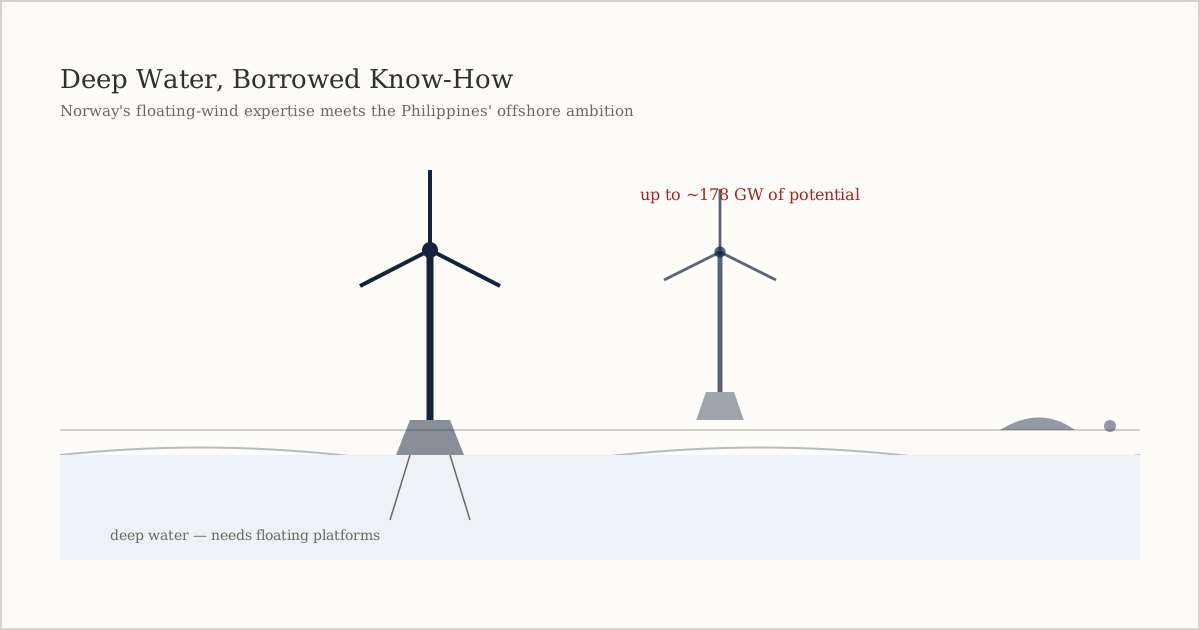
The Philippines has one of the largest offshore-wind resources in Asia and almost no way, yet, to use it. Much of the wind sits over water too deep for turbines fixed to the seabed, which means the country needs floating platforms — a technology only a handful of places have taken to commercial scale. One of them is Norway.
In June 2026, ten Norwegian energy companies met senior Philippine officials, including Department of Energy Secretary Sharon Garin, in Manila to discuss how Norway's offshore experience might help the Philippines build the sector from the ground up. Norway's credentials are not marketing. It launched the world's first full-scale floating wind turbine in 2009 and the first floating wind farm, Hywind Scotland, in 2017, drawing on skills built over decades of offshore oil and maritime engineering — subsea work, installation in rough seas, grid connection, safety and certification. The Philippines has been cited as holding offshore-wind potential on the order of 178 gigawatts, a figure far beyond its current generating capacity.
The talks were not about a single project. They covered the unglamorous scaffolding a new industry needs: policy frameworks, grid readiness, port infrastructure, logistics, safety standards, certification, and the trained workforce to run it. This is where Norway's help is most real. A country starting an offshore-wind industry cold cannot buy that institutional knowledge off a shelf, and importing it from somewhere that has already made the mistakes shortens the learning curve.
Expertise is also a foothold
None of this is charity, and Norway does not pretend otherwise. The same companies offering their expertise — developers, engineering firms, maritime contractors — are positioning to win the contracts that a 178-gigawatt ambition would generate. Standards written with Norwegian input tend to suit Norwegian suppliers. Certification regimes learned from Norwegian bodies tend to route work toward them. Being early, and being helpful, is how a country's firms get established in a market before it opens.
The talks focused on how Norwegian technology and lessons from decades of offshore development could support the Philippines as it seeks to build an offshore-wind industry from the ground up.
For Manila, that trade-off is not obviously bad. A developing offshore-wind sector benefits from experienced partners even when those partners are also bidders, and the Philippines is not obliged to hand the whole industry to any one country — the United Kingdom and others are courting the same opportunity. The risk is the familiar one for a host government: writing rules and building supply chains so shaped by foreign expertise that local firms end up as junior partners in their own energy transition, and the value-added engineering stays offshore.
Whether that happens depends on choices the Philippines makes now, while the sector is still on paper — how much local content it requires, how it structures certification, whether it builds domestic capacity alongside the imported kind. Norway is offering a genuine head start up a steep and specialized curve. The country climbing it still has to decide how much of the summit it wants to own.