
In May 2026, a claim began circulating in Kathmandu: Meta, the owner of Facebook, was said to be putting five billion rupees into a Nepali data center, with the local internet company WorldLink Communications as its partner. For a country that exports little besides labor and hydropower, it was an appealing story. It was also inaccurate.
“There is no agreement, or NDA signed between Meta and us — none,” Keshav Nepal, WorldLink’s chief executive, told the Kathmandu Post in an interview published on May 9, 2026, adding that a foreign investment of that size would have been announced at a formal event, not leaked as a rumor. The correction drew less attention than the claim. That gap, between what was announced and what was actually committed, is the most useful thing to understand about the current rush to turn the Himalayas’ surplus electricity into digital infrastructure.
The appeal is easy to state. Nepal, Bhutan and Laos generate more hydroelectric power than their small domestic markets can absorb, at some of the lowest per-unit prices in Asia, in cool climates that cut the cost of cooling a server hall. On paper, that is close to an ideal recipe for a data center. The difficulty is that a data center is not really a power project. It is a connectivity project that happens to consume a lot of power, and connectivity is exactly what a landlocked mountain country struggles to guarantee.
What was actually committed
The real money in Nepal’s digital build-out is smaller than the headlines and more structured. In July 2025 the International Finance Corporation (IFC) committed $29 million to WorldLink and its data-center subsidiary, Data World, alongside Standard Chartered Bank Nepal Limited (SCBNL). The financing is backed by the International Development Association’s Private Sector Window (IDA PSW), a facility created in 2017 to de-risk private investment in the poorest and most fragile countries. It is paying to expand fiber networks and to build a series of data centers, including what the parties describe as Nepal’s first EDGE-certified facility.
“At WorldLink, we believe that connectivity is the bridge to opportunity,” Dileep Agrawal, the company’s founder and chairman, said in the IFC press release dated July 7, 2025. IFC framed the deal in the language of national strategy. “This investment aligns with the Government of Nepal’s vision under the 16th National Plan and Digital Nepal Framework to achieve universal internet access,” said Imad N. Fakhoury, IFC’s regional director for South Asia, in the same release.
Read past the announcements and the structure is the point. A development institution takes the early risk, a guarantee window absorbs some of the downside, and a local commercial bank lends alongside — the same blended template IFC has used for roads in India and railways in the Philippines, applied here to fiber and servers. “Unlocking the full economic benefits of digital technologies requires widespread adoption and greater access, particularly in rural areas,” Vikram Kumar, IFC’s director for infrastructure and natural resources in Asia and the Pacific, said in the July 2025 release. That is a different arrangement from a single large equity investment by a global technology company.
The difference between a partner and an investor
The pattern the Meta rumor followed is not unique to Nepal. Days after the WorldLink denial, a competing developer, Bichuten Data Vault, announced a Tier-4 facility — the highest reliability tier, promising better than 99.99 percent uptime — to be built in Kathmandu and Birgunj and powered by hydroelectricity, with Google Cloud, the chipmaker AMD, the memory maker Micron and the engineering firm VVDN named as partners. The capital, though, is domestic; the foreign firms supply technology and services, not equity. Local commentators drew the obvious comparison to Ncell’s use of Oracle’s cloud software — a licensing arrangement reported, loosely, as foreign investment.
The distinction matters because it changes what the country actually receives. A technology partnership brings expertise and a recognizable brand. An equity investment brings capital that remains in the country, and an investor with a direct stake in making the project work. In Nepal’s case, the harder constraint is not the power supply.
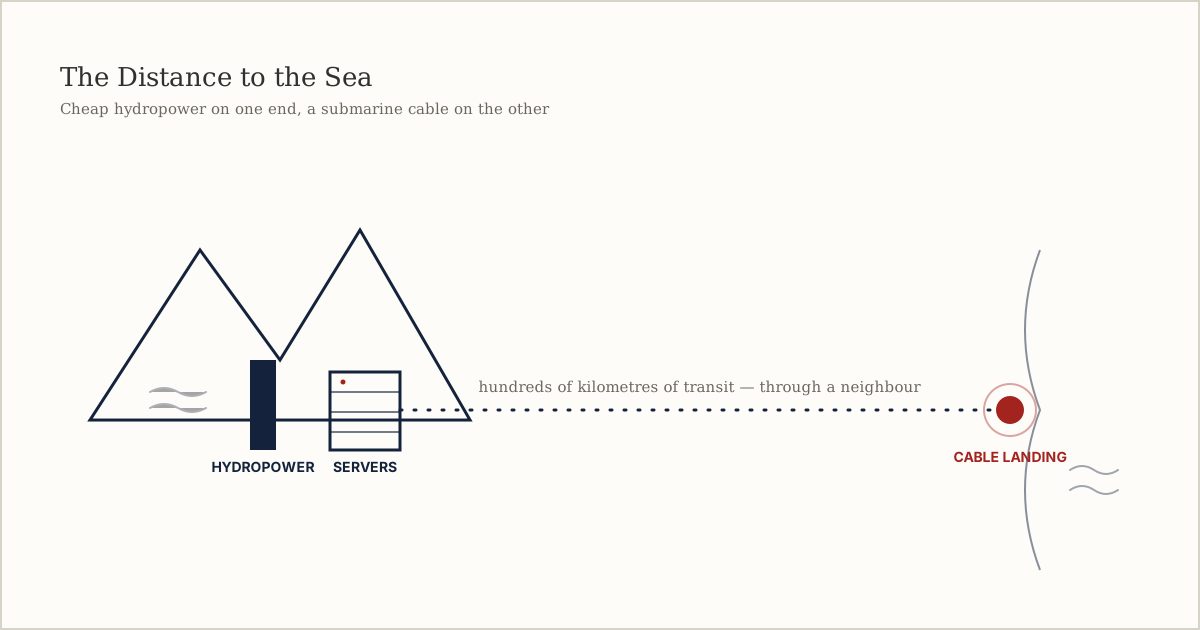
Cheap power at the source counts for little if the only link to the outside world runs through a neighbor.
The cable, not the current
Ask the people building these facilities where the constraint lies and they do not point at the grid. Nepal is “somewhat distant from submarine cables,” Keshav Nepal has said. The fiber-optic cables that carry the world’s internet traffic come ashore at coastal landing stations. A landlocked country reaches them only by routing overland through a neighbor, which means every packet of data leaving a Kathmandu server hall depends on transit across India, and on the price and reliability that transit is offered at. Cheap power at the source counts for little if the link to the outside world is long, congested or single-threaded.
This is where the economics and the geopolitics fuse. The cables themselves have become contested infrastructure. Construction of SEA-ME-WE 6, one of the main new systems linking Southeast Asia to Europe, was moved away from China’s Huawei Marine Networks to the U.S.-based supplier SubCom in 2023 after Washington objected to Chinese involvement on security grounds; China Telecom and China Mobile then withdrew from the consortium and set out to build their own. For a small state deciding how to reach the sea, the choice of route is no longer just about distance and cost. Routing through India ties into a corridor that Western partners and development banks are comfortable financing. Routing through a Chinese-adjacent corridor is often shorter and cheaper, and carries a political charge that multilateral lenders increasingly price in.
Cheap hydropower is a necessary condition for energy-intensive computing, but it is rarely a sufficient one. Surplus electricity has many productive uses. It can be exported through cross-border transmission lines, support the electrification of industry, power metals processing and other energy-intensive manufacturing, or, over time, underpin green hydrogen production. It can also fuel cryptocurrency mining, which has gravitated toward countries such as Bhutan and Laos because its principal requirement is abundant, low-cost electricity rather than extensive digital infrastructure. In each case, hydropower creates value, but through very different economic models.
Hyperscale data centers create value in a different way. Their business is not selling electricity but selling computing power, storage, and digital services to customers who may be thousands of kilometers away. Electricity keeps the servers running, but connectivity generates the revenue. That means success depends not only on reliable renewable power but also on multiple international fiber routes, low-latency links to major internet exchanges, redundant telecommunications infrastructure, cybersecurity, skilled operators, and a regulatory environment trusted by global cloud providers. A server farm can be built beside a dam almost anywhere; a globally competitive cloud region cannot.
That is why geography still matters. For landlocked states, the binding constraint is often not electricity generation but access to global digital networks. Fiber-optic corridors to the sea are the equivalent of export ports for the digital economy. Without them, abundant hydropower may support mining, manufacturing, or domestic digital services, but it is unlikely to attract hyperscale cloud investment at scale. The sequence, therefore, is difficult to escape: first secure resilient international connectivity, then build computing capacity, and only then can a broader data-center ecosystem take root.
The gap that hype hides
None of this means the ambition is misplaced. Nepal’s advantages are real, and the IFC-WorldLink deal is a serious attempt to build the unglamorous layer (fiber to homes, certified facilities, trained staff) that has to exist before any hyperscaler would consider the country. The IDA guarantee behind it exists precisely because there is “no commercial solution” yet, in the window’s own words; the point of the public money is to bring the commercial money closer.
The risk is that the announcements outrun the wiring. Every inflated claim about a Silicon Valley giant arriving makes it a little harder to see how much patient, structured, distinctly unglamorous work still stands between a mountain full of cheap electricity and a server that the rest of the world can actually reach. WorldLink runs one Tier-3 data center today, through Data World. Whether it and its rivals become a regional hub will depend on who invests in closing the distance to the sea.