
On April 20, Snr-Gen Min Aung Hlaing sat before a cabinet meeting in Naypyidaw and made his boldest offer since seizing power five years earlier: 100 days for every armed group fighting his government to come to the negotiating table. As a gesture of goodwill, his administration released more than 4,000 prisoners, including several political detainees and, most strikingly, the civilian president he had deposed in the 2021 coup, Win Myint. State media called it the opening move of "a covenant with tomorrow." The deadline he set himself is July 31 — one month from today.
That is the plan, in full. The rest is thinner than the ceremony around it. Min Aung Hlaing's government runs 31 ministries; the published 100-Day Plan sets concrete targets for five of them. The remainder, ISP-Myanmar's analysts found, reads as generalized language with no measurable commitments and nothing resembling a program for an economy that has been shrinking since the coup. The peace section is the part built to be noticed: every ethnic armed organization, signatory or not to the 2015 Nationwide Ceasefire Agreement, is expected to agree to talks before the month is out.
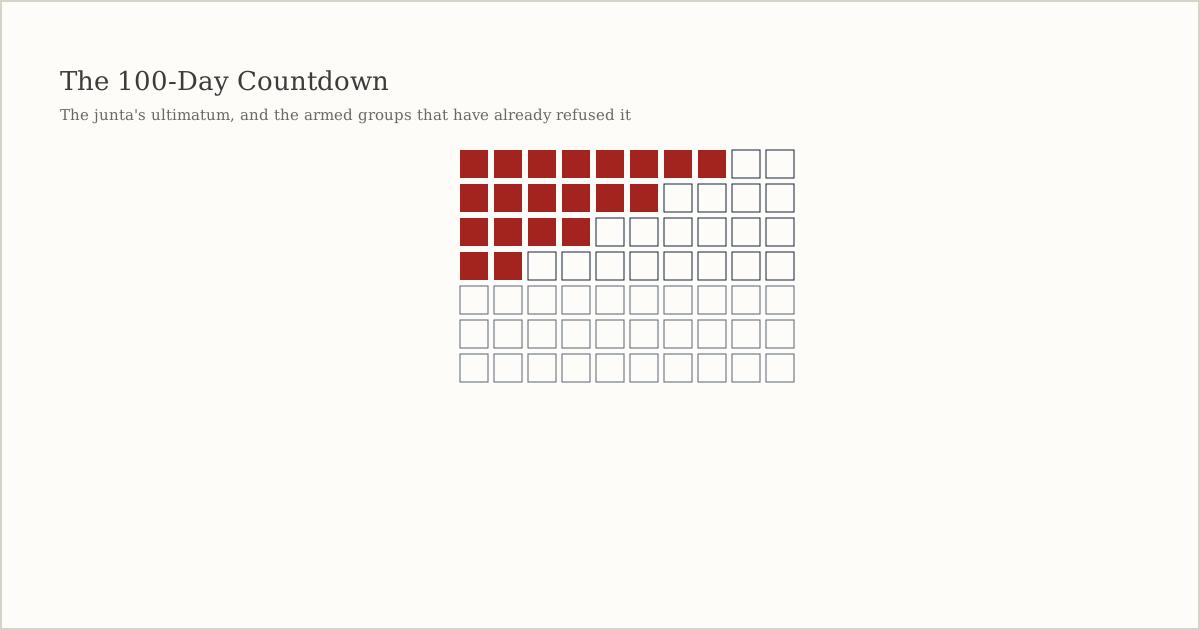
Almost none of them are expected to show up. The Karen National Union, one of the country's oldest and best-armed resistance movements, rejected the offer within days, noting it withdrew from the ceasefire framework after the coup and has "no plans to return to negotiations or follow the NCA path." The Chin National Front was blunter. "Negotiating with the junta will never work," its spokesman Salai Htet Ni said. "The regime is only making a peace offer for its own survival and interests. Their invitations mean nothing to us." The National Unity Government, the shadow administration formed by ousted lawmakers, and its allied People's Defense Forces have taken the same position: there is no genuine peace to be had while the man who ran the coup still runs the country.
"The regime is only making a peace offer for its own survival and interests. Their invitations mean nothing to us." — Salai Htet Ni, Chin National Front
Why float a plan its own authors can expect to fail? Analysts at the Shan Herald, who have tracked five years of these openings, call this one less diplomacy than a trap: a deadline built for foreign consumption, timed so the junta can say it tried and was refused, then carry on fighting and running its own electoral process regardless. July 31 was never really a deadline for peace. It's a deadline for a headline.
The fighting hasn't paused to wait for it. Much of Chin, Kayin, Kayah and Kachin States, and large stretches of Sagaing and Magway in the country's heartland, remain outside junta control, contested by EAOs and PDF units in a war that has displaced more than three million people. India, Thailand and China have all been drawn in — mostly wanting a quieter border rather than a resolution. Beijing has leaned on both sides before, protecting Belt and Road projects and its own border trade, without producing a ceasefire that lasted. Nothing in this plan suggests July 31 breaks that pattern.
A concession that actually cost the junta something — an amnesty with teeth, a real timeline to civilian rule, a seat at the table for the NUG rather than for hand-picked go-betweens — would make this time different. Nothing of the kind is on offer. The likelier outcome, the one Myanmar has watched play out several times since 2021, is a missed deadline, a restated commitment to "the peace process," and a war fought on the same terms the day after as the day before.