To honor a promise made to avoid American tariffs, South Korea built a company whose entire purpose is to send money to the United States.
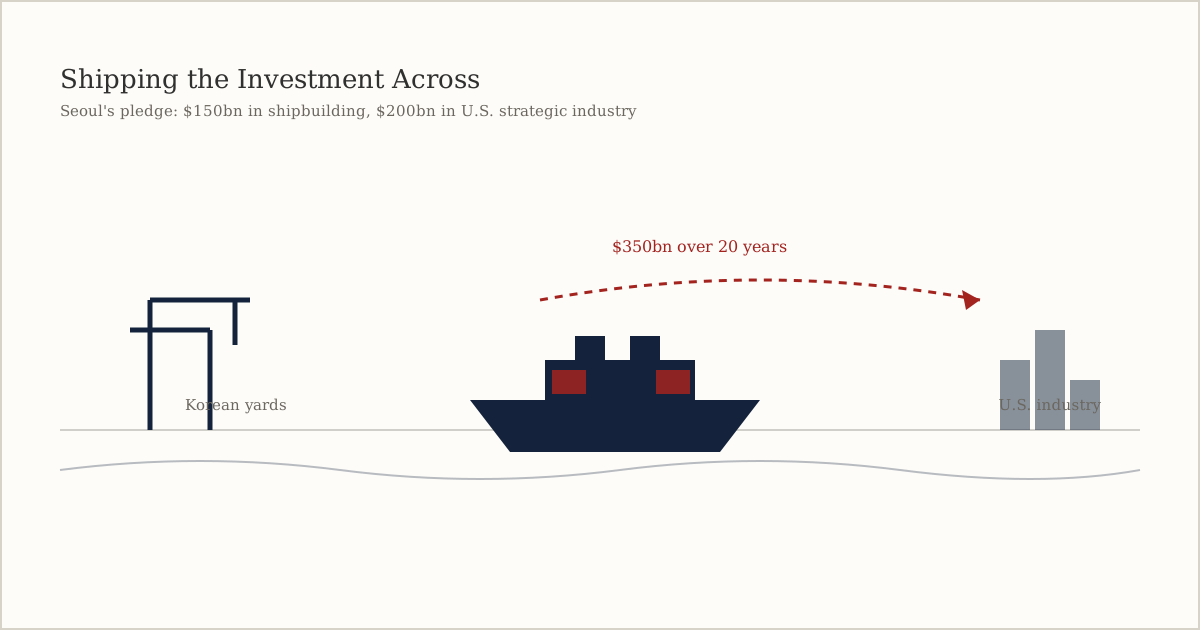
The Korea-U.S. Strategic Investment Corporation launched on June 18, 2026, after the National Assembly passed a special act in March to create it. Its mandate is to deliver on a $350 billion investment memorandum agreed with Washington: $150 billion for shipbuilding cooperation and $200 billion spread across US strategic industries — semiconductors, pharmaceuticals, critical minerals, energy, artificial intelligence and quantum computing. The government seeded it with two trillion won, about $1.3 billion, and gave it a 20-year life. At up to $20 billion of investment and loan guarantees a year, the full $350 billion would not be reached until around 2043.
The arithmetic is the first tell. A pledge that takes nearly two decades to fulfil is less a check than a treaty obligation dressed as an investment fund — a way to convert a tariff threat into a schedule of future commitments that a future government will have to keep. The immediate return is concrete: lower US tariffs on Korean goods now, in exchange for capital deployed over a generation.
The shipbuilding logic
The $150 billion for shipbuilding is the part where the two countries' interests genuinely align. The United States has watched its commercial and naval shipbuilding capacity wither while South Korea's yards became among the most capable on earth. Washington wants that capability on American soil; the US Navy has already sent requests for information to Korean shipbuilders about destroyers and support ships. For Seoul's yards, American facilities mean access to a market and a customer — the US military — that had been effectively closed to them.
China finances ports and government buildings. Washington is asking an ally to help rebuild an industry America let atrophy. Both are strategy. Only one shows up as a shipyard.
The strategic-industries half is harder to read. Directing $200 billion into American semiconductor and battery and pharmaceutical plants serves Washington's push to reshore critical supply chains. Whether it serves South Korea depends on a question the framework does not settle: is this Korean industry expanding into a new market, or Korean industrial capacity relocating out of Korea under tariff pressure?
The hollowing-out question
That distinction is the whole domestic debate. Every dollar of chip or battery capacity built in Arizona or Georgia to satisfy the pledge is a dollar not built in Gyeonggi or Ulsan. Seoul must keep access to the American market — its largest and most lucrative — without draining the domestic investment and employment that make it an industrial power in the first place. Expansion and hollowing-out can look identical on a balance sheet; they diverge only in where the jobs end up.
The corporation gives the pledge an institution and a timetable, but not an answer. It will spend the next 20 years deploying capital into a country that holds the tariff leverage, on behalf of a country that needs to keep its factories busy at home. If the plants abroad complement Korean industry, the deal bought market access cheaply. If they substitute for it, South Korea will have paid for lower tariffs with the one asset the tariffs were meant to protect. The first $20 billion tranche is now in motion. The verdict on which story is true will not be in for years.