
On July 1, 2026, South Korea reported that its semiconductor exports had hit a record — roughly $44.8 billion in a single month, part of a run that pushed the country's total monthly exports above $100 billion for the first time in its history. The same day, shares in Samsung Electronics fell 5.84 percent and SK Hynix dropped 3.40 percent.
That is not a contradiction. It is the whole story.
The chip boom is real, driven by the global build-out of artificial-intelligence infrastructure and the memory it consumes. But the market has stopped rewarding the record and started pricing the risk. A slight month-on-month dip in the unit prices of DRAM and SSD memory was enough to revive "peak-out" fears — the worry that this is as good as the cycle gets — and foreign investors extended a selling streak to nine straight sessions, pulling around $1.5 billion out. Records in the rear-view mirror do not reassure a market staring at the next turn.
When two stocks are the index
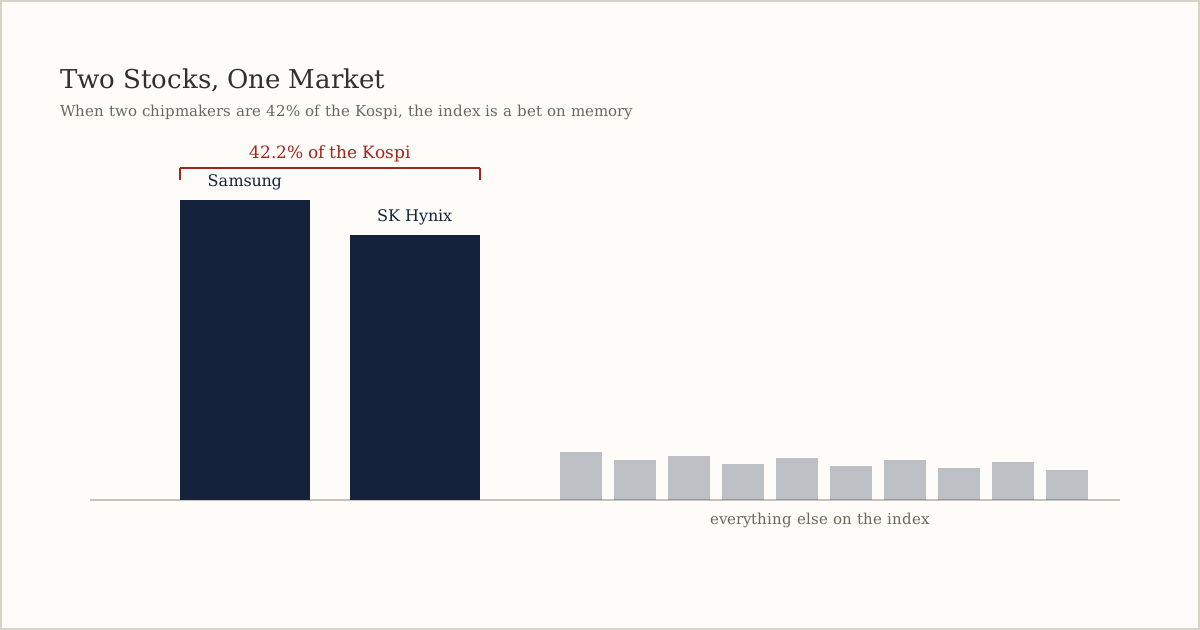
The deeper problem is concentration. By May 2026, Samsung Electronics and SK Hynix together accounted for a record 42.2 percent of the Kospi, South Korea's benchmark index. When two companies are that large a share of the market, the market is no longer a broad gauge of the economy; it is a leveraged bet on memory chips wearing the costume of a national index. A wobble in DRAM pricing becomes a wobble in the retirement savings of anyone holding a Kospi fund.
The chip cycle boosts growth and tax revenue on the way up. It exports the same volatility to the whole economy on the way down.
The Organisation for Economic Co-operation and Development (OECD) has flagged the exposure directly, warning that South Korea's deepening reliance on chip exports raises its vulnerability to external shocks. The list of things that could trigger one is not short: a pause in data-center spending by the American hyperscalers, a Chinese memory maker closing the technology gap, a geopolitical disruption to the trade in advanced chips. Any of them lands first on two companies, and through them on the index, the currency and the government's revenue base at once.
An old dependence in new clothes
South Korea has been here before, in a different form. For decades its growth ran through a handful of family-controlled conglomerates whose fortunes were, in effect, the national economy's fortunes. The country spent years trying to broaden its base away from that concentration. The AI-chip boom has quietly rebuilt it — the same structural dependence on a few champions, now expressed through semiconductors rather than shipbuilding or steel, and amplified by a stock market in which those champions loom larger than ever.
The boom has genuine winners. Chip revenue lifts exports, funds the treasury, and pays for the industrial ambitions the government is stacking on top of it. But an economy that rises on two stocks falls on them too. The question the July sell-off posed is not whether the current cycle ends — every memory cycle ends — but how much of South Korea's prosperity is now tied to the timing. A record month that the market greets with a sell-off is the sound of investors deciding they would rather not find out the hard way.