
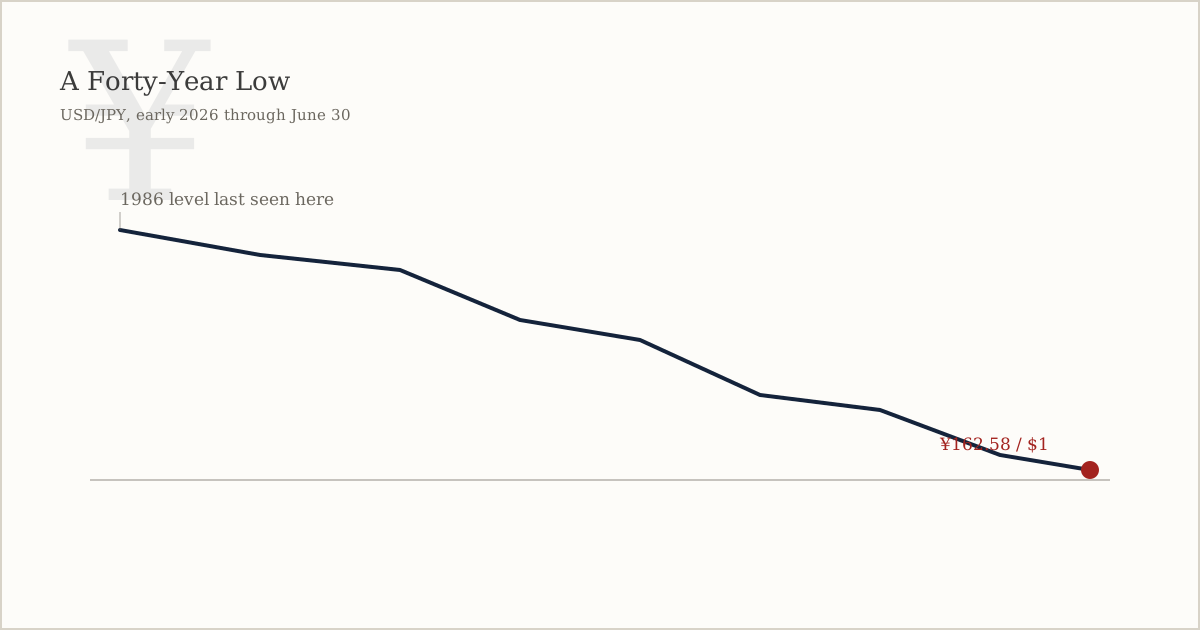
On June 30, 2026, the yen traded at 162.58 to the dollar, a level it had not touched since 1986 — a genuine 40-year low, not a figure of speech. Six weeks earlier, Japan's Ministry of Finance had disclosed that it spent 11.73 trillion yen, roughly $73.6 billion, buying yen between April 28 and May 27 in what officials described as two separate operations: one around April 30, after the currency broke through the politically sensitive 160 level, and a second in early May. It was Japan's first intervention since July 2024, and its largest on record. The yen briefly recovered to the mid-150s. Then it gave the ground back, and kept going.
The mechanism behind the slide is not mysterious. The Bank of Japan raised its policy rate to 1 percent on June 16, 2026, the highest since the 1990s. The US Federal Reserve has held its own rate at 3.5 to 3.75 percent through the same period. A gap of roughly 250 to 275 basis points keeps pulling capital toward dollar assets regardless of what Tokyo spends defending the yen in any given week. Markets now treat 162 to 163 as a fresh line in the sand — the band where traders expect the Ministry of Finance to intervene again — though thinner summer trading liquidity makes that threshold less reliable than it sounds.
What makes this cycle different from Japan's periodic currency crises is the politics sitting on top of it. Prime Minister Sanae Takaichi has spent years as one of Japanese politics' most consistent advocates for loose monetary policy; she has reportedly called rate hikes "stupid" in the past. Her government's Basic Policy document — the annual economic-policy blueprint known in Japanese as the Honebuto — calls for "appropriate monetary policy" that takes the government's own economic measures into account, language markets read as a soft warning to the Bank of Japan against moving rates any higher. A government advisory panel went further in May, urging the bank to take a "cautious approach" to further hikes. Governor Kazuo Ueda has said publicly that the bank will keep raising rates if its inflation and growth forecasts hold up. For now, those two positions are coexisting rather than colliding — but a sitting prime minister publicly leaning on a legally independent central bank is not a normal feature of Japanese economic management, and the tension is being read in currency markets as a signal that further hikes are politically constrained.
A weak yen used to be Japan's cure for stagnation. In 1985 the Plaza Accord was built to push the yen up, not down — the mirror image of the problem Tokyo is now defending against.
Who Actually Feels 162
The costs and benefits split unevenly. Japan imports about 62 percent of the calories it consumes, so a weaker yen pushes up food and energy bills directly, regardless of what it does for exporters' competitiveness abroad. Those exporters do gain from cheaper yen-denominated goods overseas, but many now face rising costs on imported components and raw materials, which blunts the advantage. The clearest winner has been tourism: Japan drew a record 42.7 million international visitors in 2025, and travel has become the country's second-largest export sector after automobiles, driven substantially by a currency that makes the country unusually cheap for foreign visitors. That advantage is not guaranteed to last. Analysts covering the tourism boom caution that visitor demand built on a temporary exchange-rate advantage can reverse as quickly as it appeared if the yen recovers — and some destination cities are already straining under the volume.
The historical contrast is almost too neat. In 1985, the Plaza Accord pushed the dollar down and the yen up, from roughly 242 to the dollar toward 153 within a year and toward 120 by 1988 — a currency shift widely blamed by economists for helping inflate the asset bubble that later collapsed into Japan's Lost Decade. Four decades on, Tokyo is fighting the opposite battle: not a yen too strong for exporters, but a yen too weak for consumers, with the same government that once might have welcomed a competitive currency now spending record sums to prop it up.
Forecasters are not unanimous that 162 is a new floor. Bank strategists surveyed by wire services in mid-2026 suggested the yen could grind back toward the 146-to-150 range by year-end if the Fed begins cutting rates, which would ease the differential driving the current slide. China's yuan, by contrast, is expected to stay a heavily managed, largely dollar-driven currency through the rest of 2026, meaning any relief for Asian currencies broadly is likely to come from Washington's rate decisions rather than from anything Tokyo or Beijing does on their own. Until then, Japan has, by the Ministry of Finance's own account, two more intervention windows it can use before informal G7 norms on the frequency of unilateral currency operations start to bite — and a prime minister whose own policy document is arguing against the one lever that would actually close the gap.