
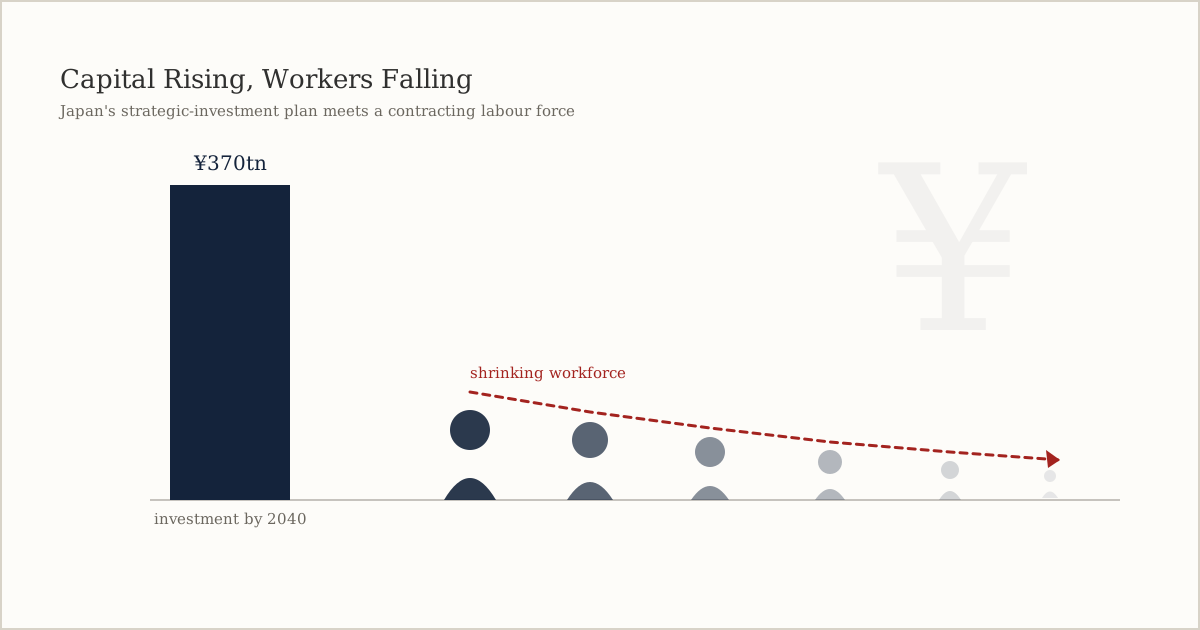
The number is the easy part. On June 24, 2026, Sanae Takaichi's government put a figure on its ambition: more than 370 trillion yen of combined public and private investment by fiscal 2040, spread across 17 sectors it deems critical to economic security — artificial intelligence, semiconductors, quantum technology, energy, medicine, even entertainment. Roughly 78.5 trillion yen of it is earmarked for chips. The plan reads like a country deciding, after three decades of caution, to spend its way back to relevance.
What the document cannot conjure is the workers to execute it. Japan's population has been shrinking since 2008; the working-age share has been falling faster. The construction crews that would pour the foundations of new fabrication plants, the drivers who would move their output, the technicians who would run them — those cohorts are contracting every year, and no line in a strategy paper reverses a birth rate. The investment target and the demographic curve are moving in opposite directions, and the second one is not up for negotiation.
Takaichi has framed the plan as a fix for the wrong problem. Japan's difficulty, she argued in unveiling it, is not that its technology or its workers are inferior to anyone's, but that domestic investment has been too low for too long. Put money to work, raise the potential growth rate, and prosperity follows. The diagnosis is half right. Capital has indeed been idle. But capital was never the only thing in short supply.
Betting on machines that do not yet exist at scale
The government's answer to the labor gap is embedded in the plan itself. About 10.5 trillion yen is directed at what it calls physical AI — robotics and automation aimed squarely at the sectors where Japan's shortages bite hardest: factories, logistics, and nursing care. The wager is that a country with dense manufacturing data and a deep industrial base can build the machines that do the work its people no longer can, and export the model before anyone else.
Automation is a plausible answer to a labor shortage. It is not yet a proven one, and elder care is the hardest place to prove it.
This is where confidence outruns evidence. Warehouse robotics and factory automation are maturing fast, and Japan is genuinely competitive in them. Elder care is another matter. It is intimate, unpredictable work — lifting, feeding, listening — and the country will need hundreds of thousands more carers within the decade for a population aging faster than any in the world. A robot can move a pallet. Whether it can bathe a frail 90-year-old with dignity is a question the 10.5 trillion yen assumes rather than answers.
The alternative lever, immigration, remains politically hemmed in. Japan has widened its foreign-worker schemes in recent years, and foreign labor now underpins whole corners of its farms, factories and convenience stores. But the expansion has been incremental and contested, and Takaichi leads a governing coalition whose base is uneasy about immigration on the scale the arithmetic implies. The strategy leans on automation partly because the more direct solution is the one the politics will not fully allow.
The arithmetic underneath the ambition
Strip away the sector list and the plan is a race between two curves. One is the investment Japan intends to mobilize; the other is the labor force available to absorb it. If physical AI matures on schedule and immigration is quietly loosened at the margins, the two curves might meet. If either assumption slips, 370 trillion yen buys capacity the country cannot staff — half-built fabs, idle logistics hubs, care homes with beds and no hands.
Japan spent the 1990s learning that money alone does not restart growth. It is about to test whether money plus machines can substitute for the one input a wealthy, aging society cannot manufacture: more working-age people. The plan runs to 2040. The demographic answer will arrive well before then.