
Ahead of their March summit, Japan resisted President Donald Trump’s public call for allies to help secure shipping through the Strait of Hormuz.
At the White House on March 19, 2026, Prime Minister Sanae Takaichi condemned Iran’s disruption of navigation and offered cooperation on energy supplies and de-escalation, but made no commitment to deploy Japanese forces. Japan’s 2015 security legislation allows only a limited exercise of collective self-defense when an attack on a closely connected country creates a clear danger to Japan’s survival. For most of seven postwar decades, a Japanese leader’s instinct in that room had been to find the yes. This time, Tokyo kept control of the answer.
The alliance held. Trump and Takaichi agreed to advance missile co-development and co-production, expand energy cooperation and reaffirm a free and open Indo-Pacific. What the meeting exposed was quieter: an ally recalculating how much of its security it can still subcontract, and a guarantor whose protection increasingly arrives entangled with trade and political pressure.
That recalculation is changing Japan’s understanding of self-defense and its role in regional security.
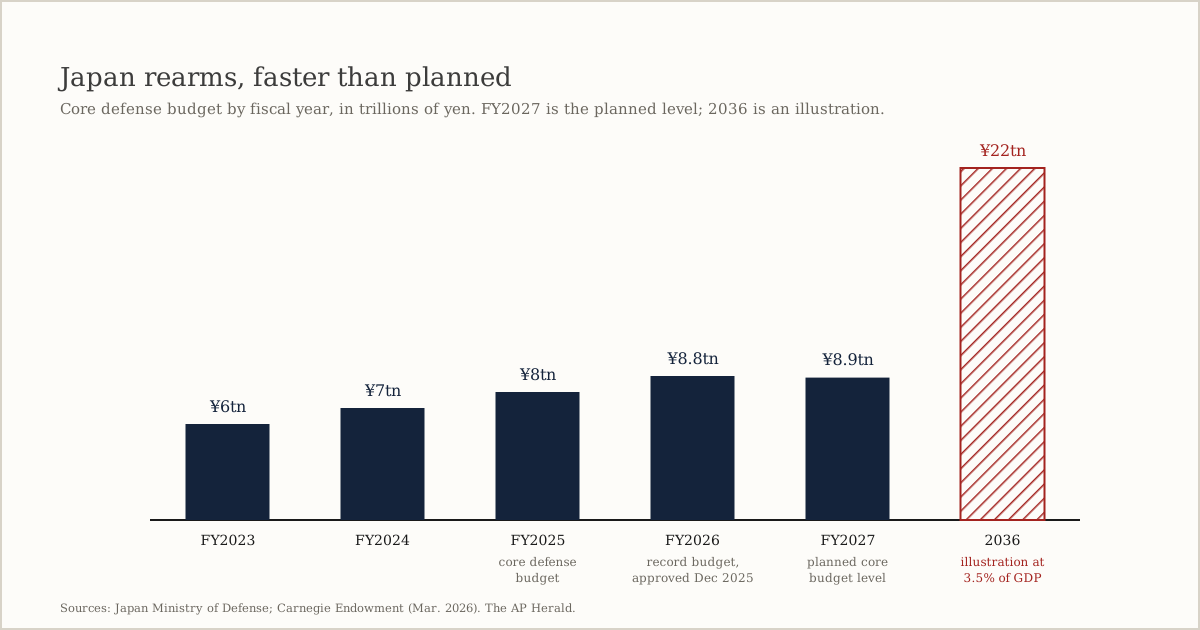
The buildup is the visible half. The FY2026 budget approved in December 2025 provided a record 8.8 trillion yen for core defense, rising above 9 trillion yen when costs related to the Special Action Committee on Okinawa and the realignment of US forces are included. Broader security-related spending reached 10.6 trillion yen. Tokyo describes that as bringing forward a spending level equivalent to 2 percent of FY2022 GDP; measured against projected FY2026 GDP, it is about 1.5 percent. The five-year buildup program through FY2027 totals about 43 trillion yen and has long set a core FY2027 level of roughly 8.9 trillion yen.
Pressure for a larger increase is building. The governing Liberal Democratic Party has cited moves by other countries toward 3.5 percent of GDP. Applied to Japan’s current economy, that would imply spending near 22 trillion yen by 2036—more than twice today’s core budget.
The institutional change is the more consequential half, because it is harder to reverse. Takaichi has committed to rewriting all three documents that frame Japanese defense—the National Security Strategy, the National Defense Strategy and the Defense Buildup Program—only four years after their adoption in 2022. Her government has already revised the five-category restriction on defense-equipment transfers, while its agenda backs submarines with vertical-launch missile tubes and next-generation propulsion.
Nuclear policy carries a sharper tension. In a 2024 book, Takaichi called the ban on bringing nuclear weapons into Japan “not realistic” while the country relies on American extended deterrence. As prime minister, she has said she did not order a review of the Three Non-Nuclear Principles and that the government continues to uphold them. Their place in the revised security documents will show how far her strategic overhaul reaches.
Nowhere is the shift plainer than over Taiwan. In parliament in November 2025, Takaichi said a Chinese attack on the island could amount to a “survival-threatening situation” for Japan, the legal condition for a military response. On a national broadcast on January 26, 2026, she declined to soften it, insisting that any response would stay inside Japan’s legal limits. Beijing called the comments a dangerous provocation.
“If the US forces, acting jointly with us, come under attack and Japan does nothing and simply runs away, the Japan-US alliance would collapse.” — Sanae Takaichi, on national television, January 26, 2026
The hedging is what turns Japan from an outlier into a marker. At their July 2 summit in New Delhi, Takaichi and Prime Minister Narendra Modi advanced the proposed transfer of Japan’s shipborne UNICORN integrated communications antenna system to India. The two governments later described it as their first defense-equipment transfer project. They placed it within wider cooperation on naval maintenance, defense manufacturing and technology under India’s Make in India program, and moved toward another foreign-and-defense ministers’ meeting in Tokyo. A decade ago Japan exported almost no military hardware. It is now preparing to equip another country’s navy.
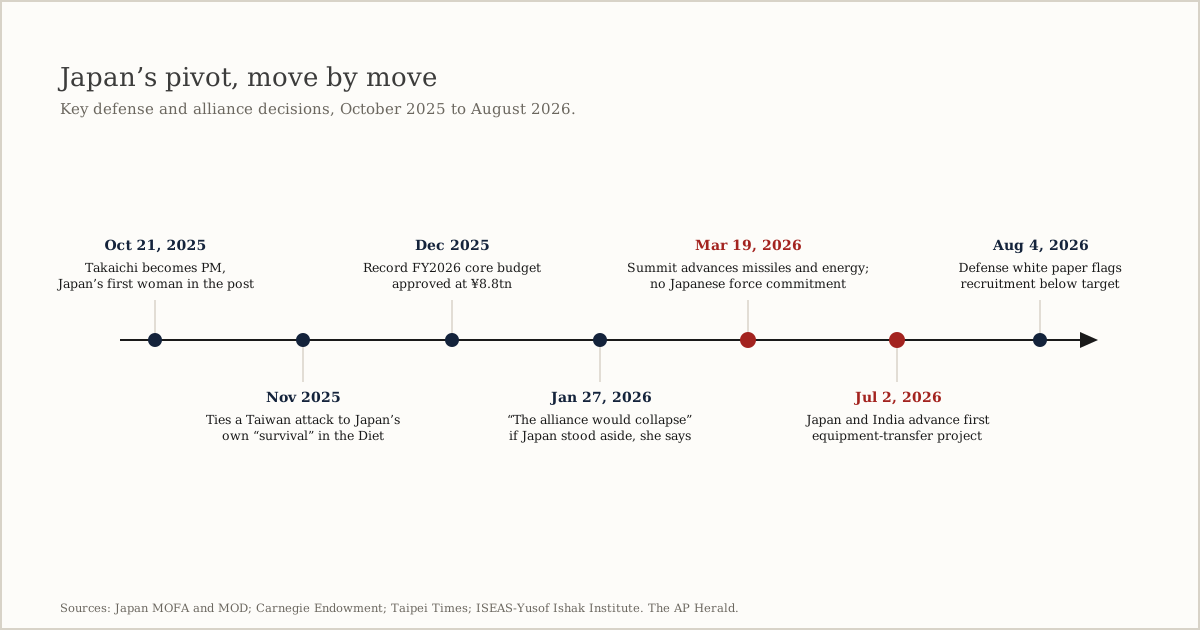
The limits are real, and Tokyo does not hide them. The yen is weak, the population is falling, and the “Defense of Japan 2026” white paper released on August 4 again flagged recruitment below target. Every credible plan for Japanese security still passes through the approximately 60,000 American military personnel based in the country.
What has thinned is certainty beneath the alliance. The Singapore-based ISEAS-Yusof Ishak Institute read the March summit as evidence of a widening gap: Trump pressed his economic priorities while offering Takaichi limited public support in her dispute with Beijing. In capitals from Canberra to Manila, such episodes deepen concern that Washington could one day prefer accommodation with China to the defense of its partners. Its allies are budgeting against that risk.
The order that organized the Asia-Pacific for a generation assumed a single guarantor with clients arranged around it. Washington’s changing tone is forcing Tokyo to adapt to an emerging reality: a Japan that spends more, revises old taboos and builds its own web of partners, planning for a lighter American presence rather than a permanent one. Whether a middle power carrying a pacifist charter and a shrinking workforce can help hold a regional balance on those terms remains to be seen.