
Markets do not usually read footnotes. In July 2026, Japan's government wrote one specifically so they would.
The document at issue is the honebuto — the annual "big-boned" economic-policy blueprint that sets the government's fiscal and economic direction for the year. An early draft contained a line that, to most readers, would have looked anodyne: the "appropriate conduct" of monetary policy was "very important." To bond traders, it read as something else — a sitting government, led by a prime minister with a long record of favoring loose money, hinting to a legally independent central bank that it should not raise interest rates any further.
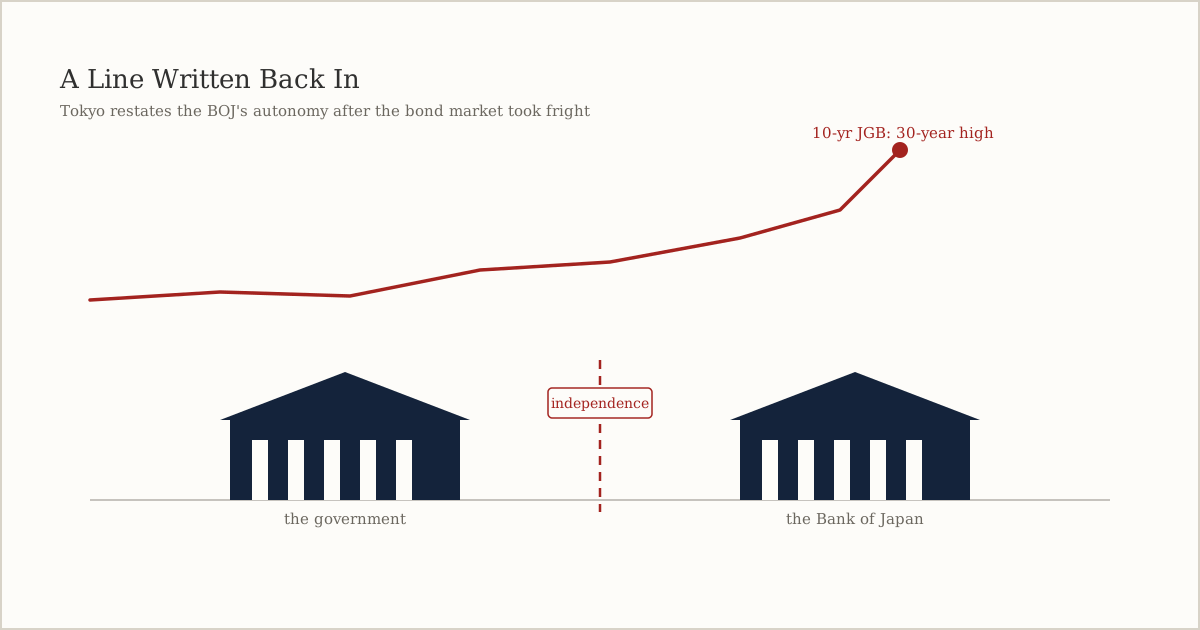
The reaction was fast and expensive. The yield on the benchmark 10-year Japanese government bond climbed to a 30-year high, and the yen wobbled, as investors priced in the risk that monetary policy in the world's most indebted advanced economy was drifting under political influence. For a state that must roll over an enormous stock of debt at whatever rate the market demands, a few words of ambiguity translated directly into a higher cost of borrowing.
The fix was fine print
So the government reached for the smallest possible instrument. Rather than rewrite its economic strategy, it added a footnote to the blueprint citing the article of the Bank of Japan Act that requires the central bank's autonomy over currency and monetary control to be respected. A later draft also tied the call for "appropriate monetary policy" explicitly to stable price increases, softening the earlier hint. Independence, in effect, had to be restated in writing to undo the damage done by leaving it unsaid.
A central bank's independence is supposed to be assumed. The moment a government has to promise it in a footnote, the market has already noticed it was in doubt.
The episode is smaller than a crisis and larger than a typo. Takaichi has spent much of her career arguing against higher rates; she inherited an economy where inflation has returned after a generation of its absence, where the Bank of Japan under Governor Kazuo Ueda has been cautiously lifting rates off the floor, and where every basis point of yield feeds through to a debt burden built up over decades of near-zero borrowing costs. The politics of wanting cheap money and the mathematics of servicing expensive debt are now colliding inside the same government.
The trap of normalization
Ueda has said publicly that the bank will keep raising rates if its forecasts for inflation and growth hold. The government's blueprint, even after the footnote, still nudges policy toward supporting demand. Those two positions can coexist while growth is decent and inflation is contained. They collide the moment the bank has to choose between fighting inflation and protecting the government's borrowing costs — and the bond market has just demonstrated how quickly it will punish any suspicion that the choice is being made in the cabinet office rather than at the bank.
That is the box Japan is in. It cannot leave rates at zero forever without letting inflation run and the yen slide. It cannot raise them freely without straining a budget engineered for an era of free money. And it cannot be seen to lean on the central bank without paying for the suspicion in yields. The revised language did not calm markets on the day it appeared; the 10-year yield hit its multi-decade high anyway. The government plans to finalize the blueprint within days. The footnote will be in it. Whether it settles the question it was written to answer is something only the next rate decision will show.