
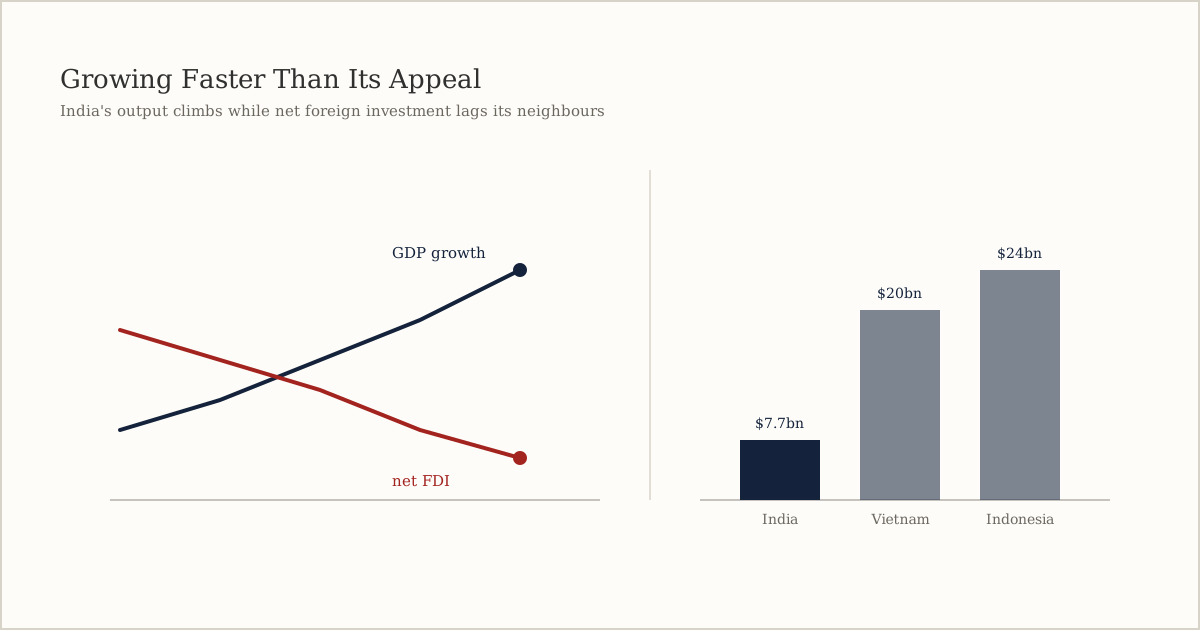
India spent 2026 telling the world it was the fastest-growing major economy, and the world's investors, on the evidence of their own money, were not fully persuaded. Net foreign direct investment for the year ending March 2026 came in at $7.7 billion. Vietnam, a country a fraction of India's size, had drawn roughly $20 billion; Indonesia, around $24 billion.
The headline number even flatters the picture. That $7.7 billion was a sharp rebound from just $1 billion the year before — but the recovery is measured against a near-collapse, and it still trails smaller neighbors by a wide margin. The gross inflows are healthier; the net figure is thin because so much capital is going the other way, as foreign firms repatriate profits or exit and Indian companies invest abroad. Money is not refusing to come to India so much as declining to stay.
That distinction points at the real subject, which is not growth but friction. India's expansion is genuine. The difficulty foreign investors describe is everything between deciding to invest and getting money back out — the practical experience of operating in the country, which does not appear in the GDP figure at all.
The gap investors actually describe
Ask the people deploying capital and the same items recur: tax disputes that drag on for years, courts that resolve commercial cases slowly, land that is hard to acquire, regulation that varies by state so that a national market is really 28 markets, contract enforcement that cannot be relied upon, and rules on repatriating capital that make the exit as fraught as the entry. Industry leaders have said as much publicly; the Confederation of Indian Industry has called for faster dispute resolution and reform of India's investment treaties to make the country a more predictable place to commit money.
Growth tells an investor how big the prize might be. Enforcement, courts and the right to take profits home tell them whether they will ever collect it.
Vietnam and Indonesia have not out-grown India. They have, for the investor, out-simplified it — clearer routes in, more predictable rules, easier exits — and in the arithmetic of where a global manufacturer places its next plant, predictability often beats scale. A larger market that is harder to operate in can lose to a smaller one that is easier, which is roughly what the FDI figures are recording.
Why the gap persists
The frustrating part, for New Delhi, is that the binding constraints are institutional rather than macroeconomic, which makes them both fixable and stubborn. A government cannot legislate faster growth, but it can, in principle, speed up its courts, settle its tax disputes, harmonize its state regulations and ease capital repatriation. Each of those, though, runs into entrenched bureaucracy, federal politics and a legal system whose pace no ministry controls. The reforms that would close the gap are unglamorous and slow, which is precisely why they have outlasted several governments that promised them.
India will keep posting growth rates that make it the envy of the emerging world, and it will keep pointing to them as proof of its investment case. The $7.7 billion is the counter-argument, delivered in the only language capital speaks. Until the experience of investing catches up with the story about investing, India will remain a country whose economy grows faster than its ability to convince outsiders to bet on it — and its smaller neighbors will keep collecting the plants, and the jobs, that the larger market assumed were its to lose.