
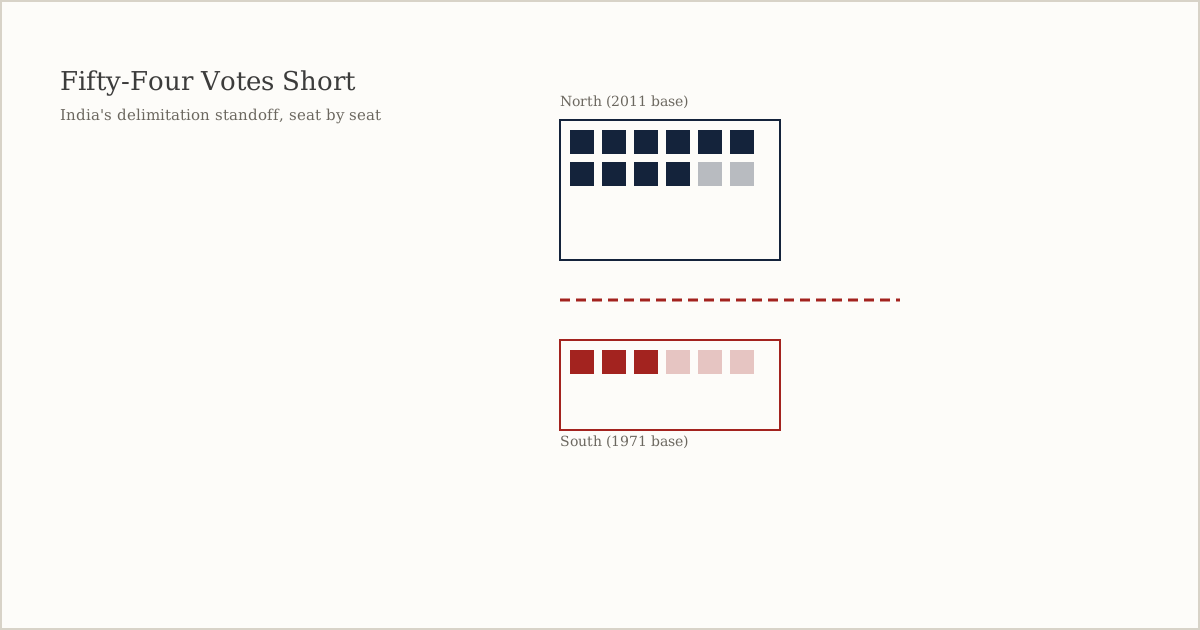
On April 17, 2026, the Lok Sabha rejected the Constitution (131st Amendment) Bill, 2026, by a vote of 298 in favor to 230 against — short of the 352 votes, two-thirds of those present, that a constitutional amendment requires. It was the first time in twelve years that a Modi government constitutional amendment had failed in parliament. The bill, introduced the day before alongside a Delimitation Bill and a Union Territories Laws Amendment Bill, was pitched by the government as the mechanism to finally activate the 2023 Women's Reservation Act, which reserves a third of Lok Sabha and state assembly seats for women. Once the lead bill fell, parliamentary affairs minister Kiren Rijiju asked the Speaker not to move the other two — the whole package collapsed together.
What the bill actually proposed went well beyond women's reservation. It would have raised the Lok Sabha's maximum strength from 550 to 850 seats, and — critically — used the 2011 census, rather than the 1971 census that has governed seat allocation for more than half a century, as the new baseline. That distinction is the real fight. A 2001 constitutional amendment had frozen each state's seat share at 1971 levels specifically to avoid punishing states that had succeeded at slowing population growth, with the freeze set to lift only after "the first census conducted after 2026." Shifting to 2011 data pre-empts that safeguard, and the numbers show why southern states object: research group PRS India's own projections show Uttar Pradesh's seats rising from 80 to as many as 89 or 133 depending on the formula used, and Bihar's from 40 to 46 or 69 — while Tamil Nadu's seats would fall from 39 to 32 and Kerala's from 20 to 15, despite both states' population shares holding steady. The four southern states most affected have spent decades investing in family planning and literacy campaigns that slowed their population growth relative to the north; the delimitation formula, as written, would have penalized exactly that success.
A Fight Amit Shah Framed as Women's Rights
Home Minister Amit Shah cast the vote in blunt terms on the floor of the Lok Sabha. "I know that if they don't vote this Bill will fall, but the women of the country are watching," he told the chamber, adding later, "You will escape by causing an uproar here but you will get the answer when you go out during polls to ask for votes... the women of this country will not forgive you." It was a framing designed to put the opposition on the defensive — vote no, and be seen voting against women's political representation.
"They used an unconstitutional trick in the name of women to break the Constitution. India has seen it. INDIA has stopped it." — Rahul Gandhi, Leader of the Opposition, on X, April 17-18, 2026
Opposition leaders answered by reframing the vote as a defense of federalism rather than an attack on women's rights. Tamil Nadu chief minister M.K. Stalin wrote that the government had "tried to divide us as North and South, to weaken and defeat us, and to redraw India's political map for their own gain," declaring "INDIA stood together and defeated their design. This is only the beginning." Congress MP K.C. Venugopal pressed the government during the debate to put a promised "50 percent increase across all seats" formula in writing; Shah's retort — "Adjourn the House for an hour and I will bring this amendment... We will do it" — never translated into text in the actual bill, a gap opposition members have continued to cite as evidence the government's floor promises did not match its legislation.
What the Defeat Does, and Doesn't, Resolve
The practical effect of the bill's failure is that the Women's Reservation Act remains legally unimplemented — its 33 percent quota was always written to take effect only after a fresh delimitation exercise following a post-2026 census, meaning enforcement was already unlikely before the 2029 election cycle regardless of this vote, and may now slip toward 2034. The defeat does not resolve the underlying north-south tension; it postpones it. Notably, the government's own coalition was not fully unified behind the bill either: Andhra Pradesh chief minister N. Chandrababu Naidu, whose Telugu Desam Party governs in alliance with the BJP, publicly criticized the opposition for the bill's defeat — even though Andhra Pradesh's own seat count would likely fall under most of the delimitation formulas the bill contemplated, an inconsistency that has not gone unnoticed by commentators tracking the coalition's internal politics.
The fight is not settled. Reporting from early June 2026 indicates government officials see a fresh opening: internal turmoil inside the Trinamool Congress, following leadership defections and a rival faction's split, has weakened the opposition INDIA bloc's cohesion, and government sources are said to be weighing whether to reintroduce the bill package in an upcoming parliamentary session. No Delimitation Commission has yet been constituted. Whether the government tries again with the same 2011-census formula, or offers the written seat-floor guarantee Congress demanded on the floor in April, will determine whether the next vote produces a different outcome — or the same 54-vote gap.