
The India–Middle East–Europe Economic Corridor was born at a dinner. In September 2023, on the sidelines of the G20 summit in New Delhi, India, the United States, Saudi Arabia, the UAE, the European Union and others signed a memorandum for a trade route that would carry shipping, rail, power cables and data lines from Mumbai to Europe by way of the Gulf. Then the region it crossed caught fire, and the corridor went quiet.
It is loud again. Europe and India have revived the push for IMEC as an alternative trade and energy route, and this time the argument is not ambition but insurance. The war that stalled the project is the same war that made planners want a second way to move goods and power between Asia and Europe — one that does not depend on a single chokepoint behaving itself.
The usual frame for IMEC is a race: can it compete with China's Belt and Road Initiative? That is the wrong question. Belt and Road had a fifteen-year head start and a construction budget IMEC will never match. The sharper question is whether the Iran war has made IMEC strategically necessary rather than merely attractive — whether, for the first time, there is a reason to build it beyond the geopolitics of being seen to build it.
The parts that are actually moving
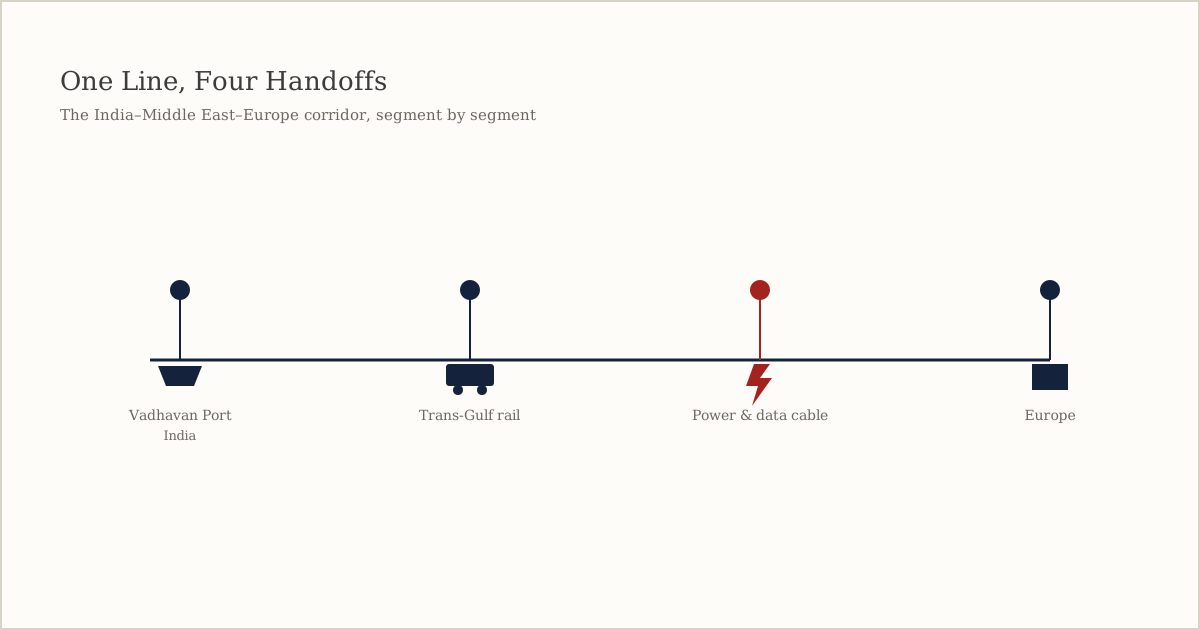
A corridor is only as real as its slowest segment, and IMEC has always been less a single project than a bundle of them: ports at each end, rail across the Arabian peninsula, undersea power cables, digital connectivity, and the unglamorous logistics — customs, standards, transshipment — that decide whether a container actually moves faster.
Some of the hardware is advancing. India's Vadhavan Port, a deepwater facility on the Maharashtra coast designed to handle the largest container ships, is moving forward as the corridor's western Indian anchor. On the Gulf side, the rail links that would carry containers overland from Emirati and Saudi ports toward the Mediterranean are the segment that turns a shipping lane into a corridor — and the one that has always been hardest to finance.
IMEC was sold as a rival to Belt and Road. Its real selling point now is simpler: it is not the Red Sea.
The power and data lines may matter more than the containers. A cable that carries Gulf solar power toward Europe, or a fibre route that gives Indian and Gulf data a path west that avoids congested and contested waters, is the kind of infrastructure that changes strategic dependence, not just shipping times.
The obstacles are the same ones that have dogged every trans-regional corridor: who pays, who operates, whose standards govern the handoffs, and whether governments that agreed over dinner will still agree once the invoices arrive. Diplomatic normalization between key partners is a prerequisite the war set back.
For a decade the pitch for IMEC was about what it could become. The war changed the tense. The pitch now is about what its absence would cost — and that, more than any summit photograph, is what tends to get infrastructure built.