
In South Africa, the Huawei ICT Academy now operates inside 47 technical and vocational colleges, 25 universities, seven private colleges and two training organizations. That is a footprint most education ministries would be pleased to claim, and it belongs to a Chinese telecommunications company better known in the West for the arguments over whether its equipment should be allowed near a national network at all.
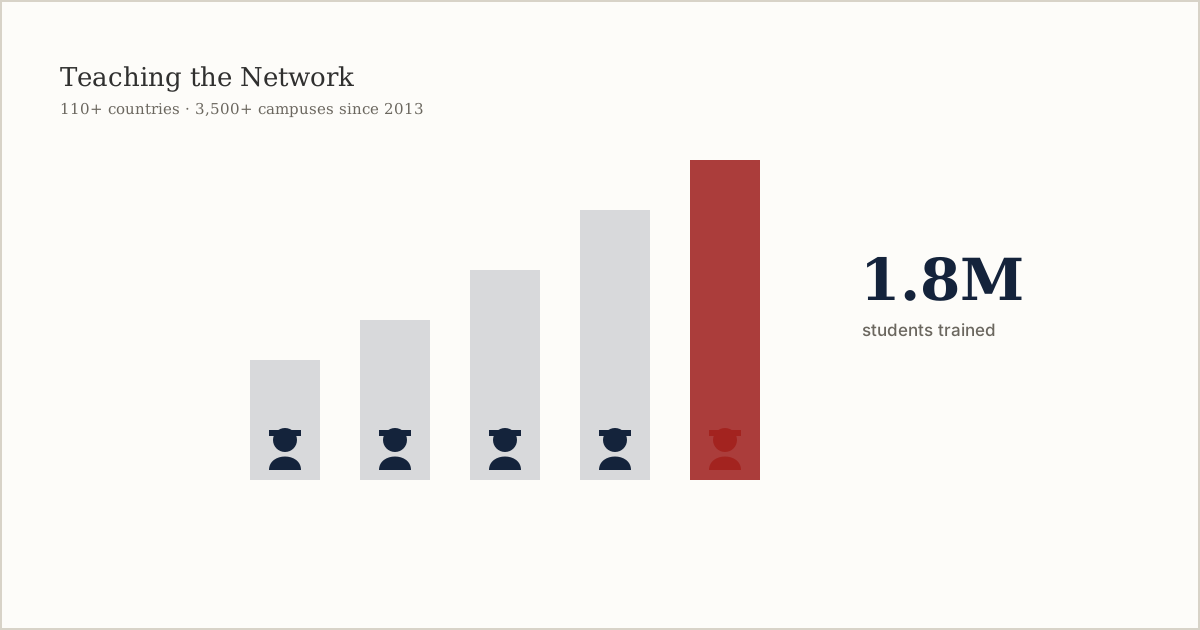
The academies are the part of Huawei that rarely makes the front page. Started in 2013, the program has partnered with more than 3,500 universities and colleges across 110-plus countries and, by the company's own count, trained over 1.8 million students, taught by a faculty of more than 11,000 instructors. The stated goal is larger still: partnerships with 6,000 schools and more than a million students a year. In sub-Saharan Africa, Huawei said in June it would train an additional 150,000 people over three years, having already put over 120,000 through its programs in the previous two—ahead of its own schedule.
For the governments involved, the appeal is straightforward. Digital-skills training is expensive to build from scratch, and a shortage of network engineers, cloud technicians and coders is a real constraint on any economy trying to move up the value chain. A company that arrives with a curriculum, certified instructors and equipment to practice on is filling a gap that domestic budgets often cannot. South African officials and colleges have generally presented the academies as workforce development, and on the numbers the training is real.
In South Africa, the Huawei ICT Academy now operates inside 47 technical and vocational colleges, 25 universities, seven private colleges and two training organizations.
There is a strategic logic underneath the goodwill, and it is not hidden. The engineers who learn on Huawei kit, certify on Huawei standards and troubleshoot Huawei systems tend to reach for the same equipment when they later specify a network of their own. It is the oldest move in the technology business—the razor and the blade, the operating system taught in every school—applied to national infrastructure. The skills are genuinely transferable; they are also, not coincidentally, most transferable to more Huawei.
For the students, the calculation is simpler than any of this. A certificate employers recognize, earned on the equipment they will meet on the job, is a way into a career that a shortage of trained engineers had been keeping shut. Western governments read the same program more warily, as a foothold in the workforce that will shape the continent's networks for a generation. But in the colleges of Johannesburg and Nairobi the nearer fact is a generation being trained for jobs that now exist, and the classroom, more than the base station, may prove Huawei's most durable contribution to the places it operates.