
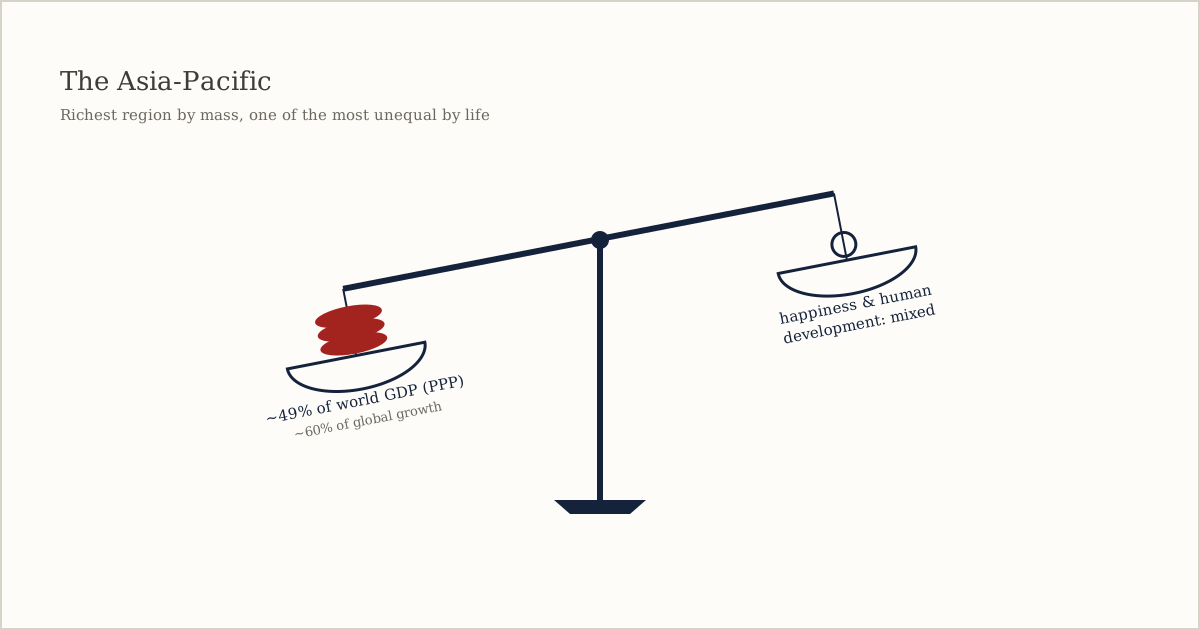
By 2030, on current projections, two of every three people in the world’s middle class will be Asian. That projection—popularized by the UNDP’s Human Development Report 13 years ago and still broadly reflected in current estimates—is the fastest way to understand where the world’s economic weight is heading. It is also, on its own, misleading. The Asia-Pacific is not rich the way Switzerland is rich. It is rich the way an ocean is large: vast in aggregate, wildly varied at any given point, impossible to sum up with one figure.
Ask how rich the region is and the honest answer is three answers, its mass, its trajectory and its lived experience, and they do not agree.
The mass
Start with weight. The Asia-Pacific holds roughly 4.8 billion people, about 59 per cent of humanity. It produces around 37 per cent of world output at market exchange rates and close to half once prices are adjusted for what money actually buys locally, near $100 trillion in purchasing-power terms. And it is where growth now lives: the IMF expects Asia to generate about 60 per cent of global growth in 2025 and 2026, even as its own pace eases to 4.5 per cent this year. The region is not catching up to the world economy. On the measures that compound over time, it increasingly is the world economy.
The Asia-Pacific is rich the way an ocean is large: vast in aggregate, wildly varied at any single point.
The trajectory
The mass is still growing, and the growth is a consumer story. An estimated 2 billion Asians were middle class in 2020; by 2030 the figure could reach 3.5 billion, and the Asia-Pacific is on track to supply about two-thirds of the entire new global middle class this decade. That is the number reshaping boardrooms from Paris to Seoul: across the 2020s, a rising share of every discretionary dollar spent on earth will be spent by someone in this region. Rising incomes, cheap smartphones and a fast post-pandemic recovery are the engines.
The resources
Wealth here is also literal, what is in the ground and under the sea. The region holds a commanding position in the materials the energy transition runs on. Indonesia alone supplies roughly 60 per cent of the world's mined nickel; China processes somewhere between 70 and 95 per cent of the planet's lithium, cobalt and graphite and the bulk of its rare earths; Australia is a top supplier of lithium and iron ore. The region does not merely make the world's goods. It increasingly controls the inputs to everyone else's, a form of wealth that never shows up in a per-capita table.
The spread
Now the disagreement. Averaged across 4.8 billion people, the region's prosperity dissolves into extremes that sit side by side. Singapore, Japan, South Korea and Australia rank in the UN's “very high human development” tier, with incomes and life expectancies among the best in the world. In the same region, Afghanistan sits near the bottom of the same index, and hundreds of millions across South Asia still live close to subsistence. The Asia-Pacific contains both the highest-tech societies on earth and some of its poorest, often within a few hours' flight of each other. “Rich” is true of the region and false of most of its people at once.
The wellbeing gap
The starkest gap is between money and how life actually feels, and the World Happiness Report makes it measurable. Its 2026 edition uses a three-year average of life evaluations and the region lands all over the table, rarely where GDP alone would predict. Australia ranks 15th in the world; Taiwan 26th; Singapore, the richest economy in Asia per head, 36th; Japan 61st; China 65th; and India, on track to be one of the largest economies on earth, 116th.
Read that list and the point is unmistakable: in the Asia-Pacific, wealth and wellbeing have come uncoupled. Japan is one of the richest societies on the planet and ranks in the middle of the global happiness table; India is projected to be among its largest economies and sits near the bottom. Aggregate riches, the numbers say, do not automatically become a good life.
The clock on all of it
Whether the mass converts into durable wealth turns on demography, and the demography is turning first at the top. China's working-age population began shrinking in the mid-2010s. Japan's has been falling for a generation. South Korea has recorded the lowest fertility rate of any economy in peacetime, below 0.8 children per woman. The IMF now names population aging as the main drag on the region's medium-term potential. The Asia-Pacific became the center of the world economy while it was young. It will spend the next quarter-century finding out whether it can stay there while it grows old.