
In May, a South Korean attack submarine surfaced off the coast of British Columbia. It had not come to fight. Hanwha Ocean's KSS-III boat had crossed the Pacific to be inspected—a diesel-electric sales pitch sitting in Canadian water, backed by a campaign that put Korean defense advertising in Canadian airports, on Canadian television and along Canadian transit lines. The message to Ottawa was hard to miss: this navy builds submarines that already work, and it can build yours.
On July 6, Prime Minister Mark Carney gave his answer, and it was no. Canada's largest defense procurement ever—a program worth up to C$60 billion to replace four aging Victoria-class boats with twelve new submarines able to patrol the Arctic, the Atlantic and the Pacific—will go to Germany's ThyssenKrupp Marine Systems and its Type 212CD, a boat built around a diamond-shaped hull and a hydrogen fuel-cell drive that lets it sit under the ice almost silently. Hanwha, bidding alongside HD Hyundai Heavy Industries, was named the reserve supplier. It is the seat you take when you have lost, with a ticket back into the room only if the winner stumbles.
What makes the result worth a second look is how good the losing bid was. Hanwha offered the KSS-III Batch II, a submarine already in service with the South Korean navy rather than a design still on the drawing board. It promised the first four boats by 2035 and all twelve by 2043—ahead of the German timeline. It pledged more than C$70 billion in trade and investment and some 25,000 Canadian jobs a year through 2044. Then it sailed the actual submarine to Canada so that officials could stand on the hull. Ottawa still chose the European boat, and the reasons had less to do with steel than with the alliance the steel came wrapped in: a German submarine is a NATO submarine, built by a country Canada will sit beside in every future crisis in the North Atlantic.
The Korean bid pledged more than C$70 billion in trade and investment and some 25,000 Canadian jobs a year through 2044.
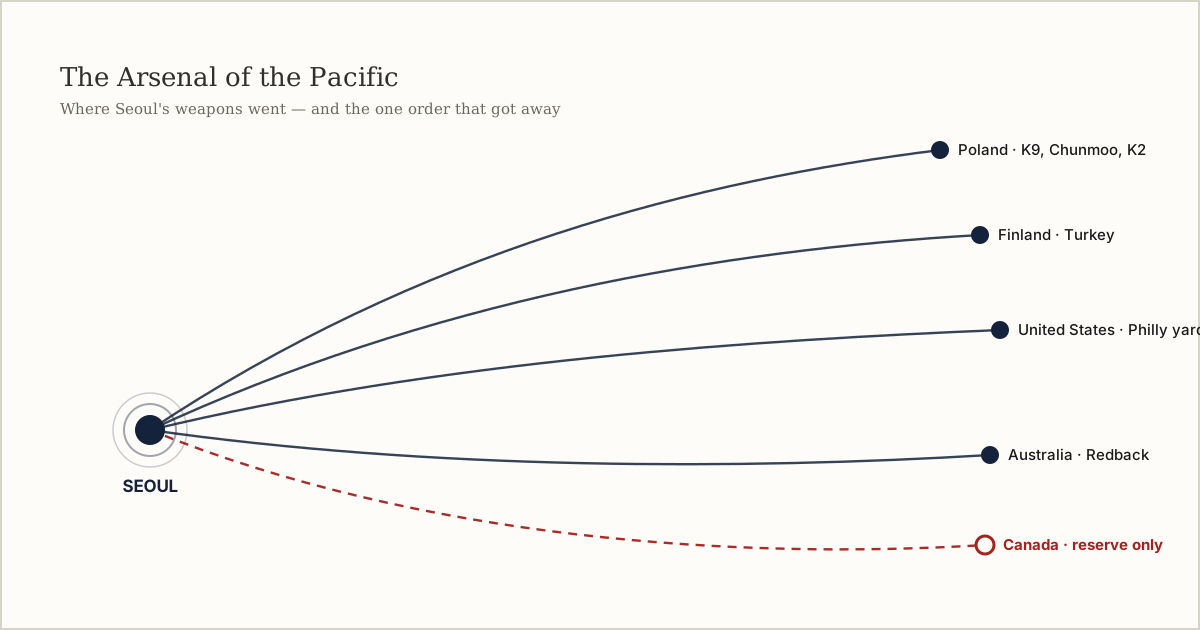
Consider what Hanwha actually is. It is not a shipbuilder that wandered into arms sales. Hanwha Aerospace makes the K9 Thunder self-propelled howitzer, which now holds roughly half of the world market for its class—about 1,560 guns in service, with Turkey, Poland and Finland each fielding more than two hundred. Its K239 Chunmoo rocket launchers have gone to Poland by the hundred, in contracts worth more than five billion dollars. Its Redback infantry fighting vehicle beat Germany's Rheinmetall for an Australian order in 2023, on the German company's home turf of armoured vehicles. Hanwha Ocean, the former Daewoo yard that builds the KSS-III, is the naval arm of the same conglomerate. When Seoul set itself the goal of becoming the world's fourth-largest arms exporter by 2027—behind only the United States, Russia and France—Hanwha was the company expected to carry most of the weight.
The engine of that climb has been Poland, which after February 2022 looked at its eastern border and decided it could not wait years for Western factories to clear their backlogs. A single 2022 framework deal sent Polish buyers to Seoul for tanks, howitzers, light attack jets and rocket artillery worth some $12.4 billion. Korea's pitch was never that its weapons were the cheapest or the most advanced. It was that they existed, in numbers, soon—that a Korean yard could deliver next year what a European or American one would quote for the next decade. In a rearming world, availability turned out to be a weapon of its own.
The strategy has since reached the one market that matters most. Hanwha bought Philadelphia's Philly Shipyard for $100 million in late 2024, poured in hundreds of millions more, and has begun taking on maintenance and repair work for a U.S. Navy whose own yards cannot keep pace with their backlog. In December it won its first American defense order, machining parts for Boeing's F-15. A Korean company is now being talked about, out loud, as a builder of warships for the United States—an idea that would have been dismissed as fantasy when the K9 was still looking for its first foreign buyer.
Which is why the view from Seoul this week is not the one a scoreboard would suggest. Canada picked the German boat, and Hanwha will grumble about the fine print of alliance politics. But the reserve supplier's chair is not nothing: if the TKMS negotiations slip before Ottawa signs at the end of 2027, the submarine that already sailed to British Columbia is the one waiting in the wings. Losing a deal this size and still being the fallback for it is a position no Korean arms maker could have imagined a decade ago. The question now is not whether the world's buyers will call Seoul. It is who they will stop calling instead.