
Trade statistics rarely announce a turning point. They record one after it has already happened.
Two numbers from the first half of 2026 describe a shift the Gulf has been talking about for a decade and is now living. Trade between the Gulf and Southeast Asia rebounded 14.8 percent, recovering ground lost to a year of regional disruption. Commerce between the United Arab Emirates and what economists loosely call emerging Asia reached $268 billion. Neither figure is a forecast. Both are the pivot east, arriving as an accounting fact.
The temptation is to file this under China. It is bigger than China. Beijing remains the Gulf's largest single Asian partner, but the story the raw totals hide is diversification: the fastest growth is now spread across India, the members of ASEAN, South Korea and Japan. The Gulf spent years selling China its oil. It is now selling, financing and building across the whole of Asia's eastern seaboard.
Why now, and why it sticks
Three forces are pushing in the same direction, and only one of them is oil. The first is trade architecture: a run of new agreements — comprehensive economic partnerships between Gulf states and India, Indonesia and others — has lowered the friction on goods that used to move despite the paperwork, not because of it. The second is sovereign wealth, which has turned Gulf capital from a spectator on Asian growth into a shareholder in it. The third is the energy transition, quietly rewiring what the Gulf sells: less crude, more petrochemicals, fertilizer and aluminum, and eventually the hydrogen and ammonia that Japan and South Korea are betting their industrial futures on.
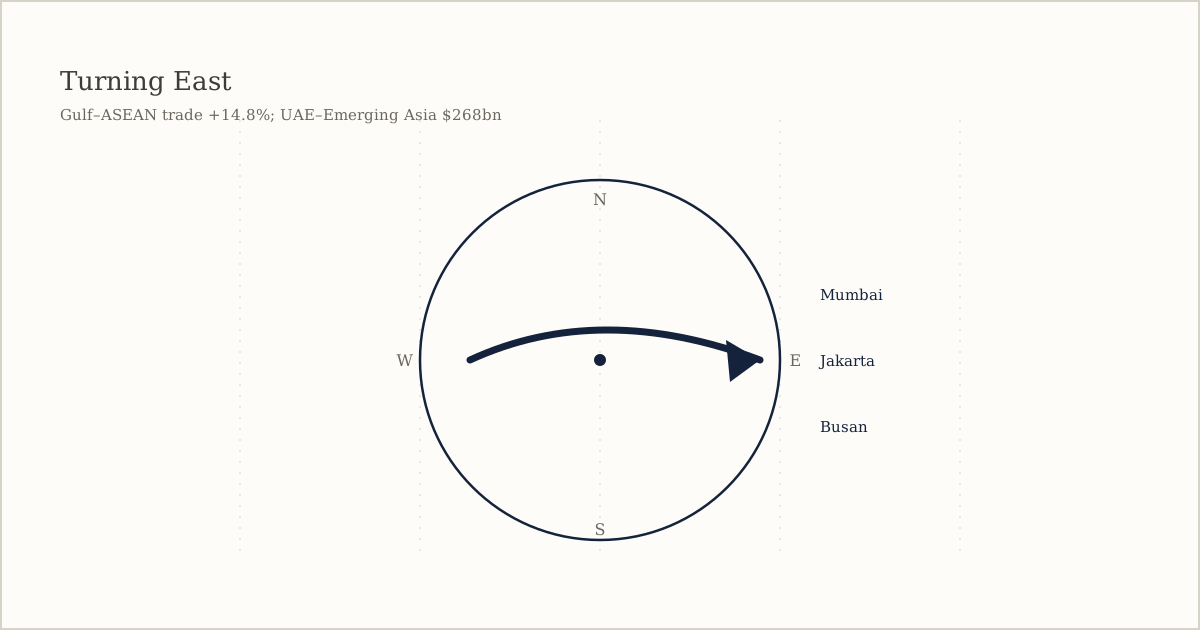
For half a century the Gulf's economic geography pointed west. The map is being redrawn, and it now points at Mumbai, Jakarta and Busan.
What makes this look structural rather than cyclical is that it survived a bad year. A regional war disrupted shipping and rattled investors, and the trade lines bent without breaking. Cyclical relationships snap under that kind of stress. Ones built on treaties, equity stakes and multi-year supply contracts bend and then keep going.
There is a longer history under the numbers. The Gulf and Asia traded across the Indian Ocean for centuries before oil, moving pearls, dates, textiles and pilgrims along monsoon routes that predate every modern border. The twentieth century, with its pipelines to Europe and its dollar-priced crude, was in some ways the interruption. What looks like a pivot may be closer to a return.
The open question is what the Gulf becomes on the far side of it. A supplier that happens to sell more to Asia is one thing. A region whose ports, funds and industrial plans are wired into Asian demand is another. The second is far harder to reverse — and the 2026 figures suggest it is the one taking shape.