
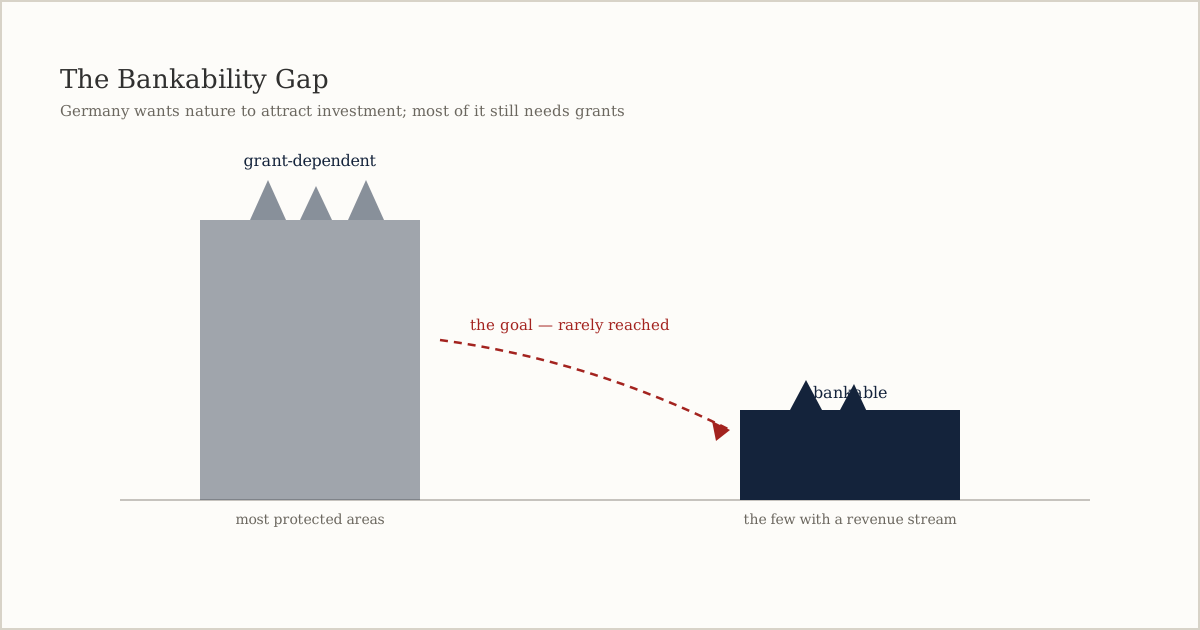
The problem German nature finance is built to solve can be stated in one sentence: conservation costs money and almost never makes any. A protected rainforest generates carbon storage, biodiversity and clean water — public goods that markets do not pay for — which is why the world's protected areas run overwhelmingly on grants and government budgets, not investment. Germany has spent years trying to change that arithmetic, with mixed and instructive results.
Its flagship is the Legacy Landscapes Fund, set up in 2020 by the German development bank KfW on behalf of the government, starting with around 82.5 million euros. The fund pairs public and private money to give long-term, reliable financing to a portfolio of biodiversity hotspots — it aims to back more than 30 outstanding protected areas by 2030 — across Africa, Asia and Latin America. In October 2025, representatives of 15 of those landscapes gathered in Berlin to present their work. More recently, in May 2026, Germany joined the Asian Development Bank's Nature Solutions Finance Hub as a financing partner, adding 5.5 million euros in grant cofinancing aimed specifically at Asia and the Pacific.
The ambition is coherent and, in parts, working. A permanent endowment that pays a protected area's running costs year after year is more useful than a three-year grant that lapses, and blended structures that use public money to cushion private investors can, in the right project, pull in capital that would otherwise stay away. Germany is also honest about the barrier. The ADB hub it joined exists, in the hub's own description, to tackle two things: a shortage of bankable investment projects and a lack of financial instruments to attract private capital at scale.
Bankable is the hard word
That phrase — bankable — is where the ambition meets reality. For an investment to attract private money, it needs a return, which means a revenue stream: carbon credits, sustainable tourism, certified commodities, payments for watershed services. Some landscapes have one. Most do not, or have one too small and too uncertain to satisfy a commercial investor. The result is a portfolio that splits in two: a handful of projects with a credible business model that can draw investment, and a much larger set that remains, and will remain, dependent on grants.
The ADB hub Germany joined exists, it says, to address a shortage of bankable investment projects and a lack of instruments to attract private capital at scale.
That split is the story the promotional version obscures. "Mobilizing private capital for nature" is true at the margin and misleading as a headline, because the marginal project is the exception. The danger in overselling bankability is that it invites governments and donors to treat private finance as the plan rather than a supplement, and to quietly assume the grant money can taper — when the evidence so far is that most conservation still cannot pay its own way.
Germany's contribution is best judged narrowly and concretely. The Legacy Landscapes model provides something conservation genuinely lacks — durable, predictable funding — and that alone is worth doing regardless of whether a rupee of private capital ever follows. The nature-finance hubs are a reasonable experiment in widening the pool. What neither has yet done, and what the honest metric would track, is shift the balance: how many protected areas in Asia and the Pacific have moved from grant-dependence to a real investment case, and how many are still, after all the financial engineering, waiting for the next grant.