
The NAM Expressway (the Narketpally–Addanki–Medarametla road) is a 212-kilometer toll road running across Andhra Pradesh and Telangana, part of the shortest route between Chennai and Hyderabad. In February 2025 it changed owners. No ribbon was cut, no new lane was poured. Cube Highways Trust, an Indian infrastructure investment trust (InvIT), simply bought the company that holds the concession for 717.6 crore rupees and folded another operating toll road into its portfolio.
What made the deal notable had nothing to do with the asphalt. To finance the purchase, Cube issued the first sustainability-linked bond ever floated by a road InvIT in India. The anchor buyer was the International Finance Corporation (IFC), a member of the World Bank Group and the largest global development institution focused on the private sector in emerging markets, which put in 860 crore rupees, about $98.35 million. IFC did not build the road, or lend to whoever once did. It bought a bond, backed by tolls drivers were already paying, and structured it so other investors would follow.
This is what a large part of development finance in Asia now looks like. The image of the multilateral bank as a builder of things, the institution that writes a sovereign a check and watches a dam or a highway appear, describes less and less of what these banks actually do. Increasingly they arrange, guarantee, anchor and de-risk. The concrete gets poured by someone else, ideally with private money, and the bank’s balance sheet stands one or two steps back from the physical work.
Three deals, in three countries, trace the change.
The platform
Cube Highways is not a construction company. It is a portfolio—27 highways, close to 8,400 lane-kilometers of them, assembled largely by winning what India calls Toll-Operate-Transfer (TOT) auctions. Under that model a private operator pays the National Highways Authority of India (NHAI) a single upfront sum for the right to run, maintain and collect tolls on an existing stretch of national highway for 30 years. In 2020 Cube paid $684 million in one go for nine such roads. The company builds nothing. It buys traffic that already exists.
Behind it sits a roster of institutional capital that says a good deal about how this asset class is now financed: I Squared Capital, which controls the platform; a subsidiary of the Abu Dhabi Investment Authority; British Columbia’s public pension manager; Abu Dhabi’s Mubadala; and Japan Highways International. These are patient investors looking for bond-like returns from roads that behave, more or less, like utilities.
IFC’s role in the NAM bond was to make that market a little deeper. “This collaboration highlights the critical role of InvITs in expanding and diversifying sources of investment within the road sector,” said Imad N. Fakhoury, IFC’s regional director for South Asia, in the press release announcing the bond on February 13, 2025. The framing put the trust structure, not the road, at the center. As the anchor investor, IFC’s money was meant to pull in others; the sustainability label attached covenants to the borrowing, tying the cost of the debt to environmental and social targets. It is a long way from lending a transport ministry the price of a bridge.
The logic is brownfield first. Construction risk—the danger that a project runs late, runs over, or never opens—is the hardest thing for private capital to price. Strip it out by financing only roads that already carry cars, and the asset starts to look investable to pension funds and insurers who would never touch a greenfield build. The development institution’s job becomes recycling capital, freeing money that was locked in operating assets so it can chase the next thing that does need building.
The bank no longer promises to build the railway. It promises that the government will pay—and rents out its credit rating to make that promise believable.
The guarantee
Fifteen hundred kilometers to the east, the Philippines is testing a different version of the same instinct. The North-South Commuter Railway (NSCR) is a 147-kilometer line that will run from Malolos, in Bulacan, through Manila and down to Calamba, with a spur to Clark International Airport. At roughly 873 billion pesos, co-financed by the Japan International Cooperation Agency (JICA) and the Asian Development Bank (ADB), it is one of the largest rail projects in the country’s history. The trains and tracks are being built with public and concessional money. The question is who will run them.
Manila’s answer is a public-private partnership (PPP) worth about 229 billion pesos, under which a private consortium would operate and maintain the railway for 15 years in exchange for regular “availability payments” from the transport department—fixed sums paid for keeping the system running well, whether or not ridership meets forecasts. That structure shifts revenue risk off the operator. It also asks bidders to trust that a government will keep paying, on time, for a decade and a half.
Bidders, it turns out, wanted more than trust. So in early 2026 the government asked ADB for a partial credit guarantee of up to $800 million—the equivalent of two years of availability payments. In the words of ADB’s own project data sheet for the transaction, reported in March 2026, the guarantee would “backstop a standby letter of credit issued by a reputable commercial bank, mitigating liquidity risk and enhancing bankability.” Read plainly: if Manila misses a payment, a commercial bank covers it, and ADB stands behind the commercial bank. The development lender is not funding the railway. It is insuring the state’s promise, so that private operators show up to bid.
And they have. The roadshows the transport department ran in Tokyo, Singapore and Paris drew an unusually deep field: Japan’s JR East and JR West, the Paris operator RATP Dev, the French groups Keolis and Transdev, and local heavyweights San Miguel, Ayala and First Balfour. The bar to enter is steep—a minimum net worth of 114.65 billion pesos, and at least one consortium member with a decade of experience running a line that moves 45,000 passengers an hour in each direction. The final concession terms were due at the end of April, with bids to follow. Whether the guarantee is what tips a cautious operator into a firm bid is, in a sense, the whole experiment.
The template
Both of these owe something to an older model, one that still does the unglamorous work of lending governments cheap money to build. For that, look at the metro systems now threading through Indian cities. By May 2024 JICA had approved 56 loans worth about 3.7 trillion yen, roughly $23.5 billion, for metros in Delhi, Mumbai, Kolkata, Chennai, Bengaluru, Ahmedabad and, more recently, Patna. The loans are concessional: long tenors, low interest, the kind of terms no commercial lender offers and no development bank expects to profit from.
Delhi’s metro became the reference design. It paired decades of soft Japanese loans with a corporatized operator able to capture value from the land around its stations, and it was disciplined enough that other cities wanted to copy it. The copying is now reaching places with far thinner economics than the capital. JICA’s loan for the Patna metro, about 98.6 billion yen, backs a system in a mid-sized city where fare revenue will strain to cover operating costs, let alone debt. The record for JICA’s single largest project loan anywhere in the world belongs to another Indian venture, the Mumbai-Ahmedabad high-speed rail, at 18,750 crore rupees, a measure of how much Japanese capital is riding on the model holding up.
The catch is that the template travels only so far. Concessional lending on this scale works where a government can offer a sovereign guarantee and a competent, ring-fenced operator to run the asset. Take those away and cheap debt becomes an expensive liability. That is precisely the missing layer: the corporatized operator, the deep secondary market, the credible payment record that the smaller economies of the region most often lack.
What the model can and cannot do
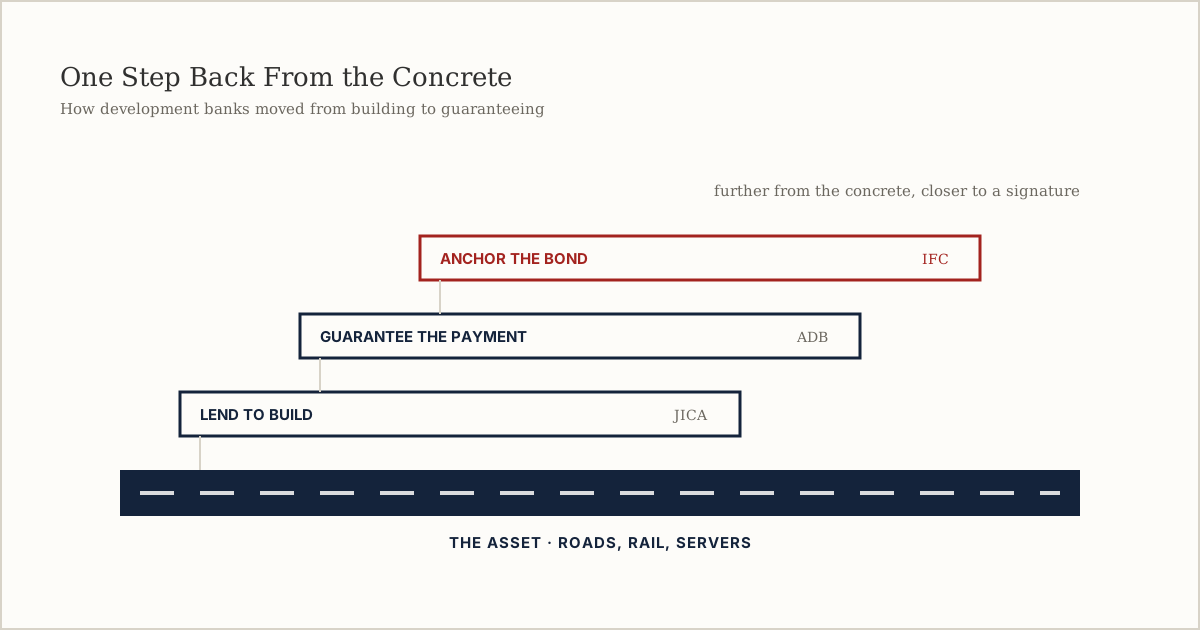
Lined up together, the three deals look less like separate stories than points on a single line of retreat from the concrete. JICA lends cheaply to a state that builds and runs the railway itself. ADB guarantees a state’s payments so a private operator will run what the state built. IFC anchors a bond so capital markets refinance what private equity already owns and operates. At each step the public institution moves further from the physical asset and closer to being a layer of credit enhancement—a signature, a backstop, a rating lent out for a fee.
For the banks, the appeal is arithmetic. ADB has told its shareholders it wants to mobilize $2.50 of other people’s money for every dollar of its own private-sector financing by 2030, against a regional infrastructure bill it puts at more than $1.7 trillion a year. No development budget on earth closes a gap that size by writing checks. The only way the numbers work is if each public dollar is used to unlock several private ones, which is what guarantees and anchor investments are designed to do.
The limits show up where the institutions are weakest. A toll-road platform can recycle capital only where there is a deep stock of operating roads to buy and a market that will price them. A payment guarantee reassures an operator only where a government’s promise is worth guaranteeing in the first place. For Nepal, Bangladesh or Sri Lanka—economies with shallow asset markets, thin institutions and stretched public balance sheets—the lesson is inconvenient: you cannot guarantee your way past a missing operator or an untested legal framework. The sequencing runs the other way. The institutions come first, then the clever financing.
For now, the NAM Expressway keeps collecting tolls from drivers with no idea whose bond their small change is servicing. In Manila, the bids for a railway that is nearly built will test whether a bank’s promise to cover a government’s promise is enough to bring the operators in. The banks are betting that standing behind the money mobilizes more of it than spending the money ever could. Across a region that needs more than a trillion dollars a year it cannot raise on its own, that bet is no longer at the edge of development finance. It is the center of it.