
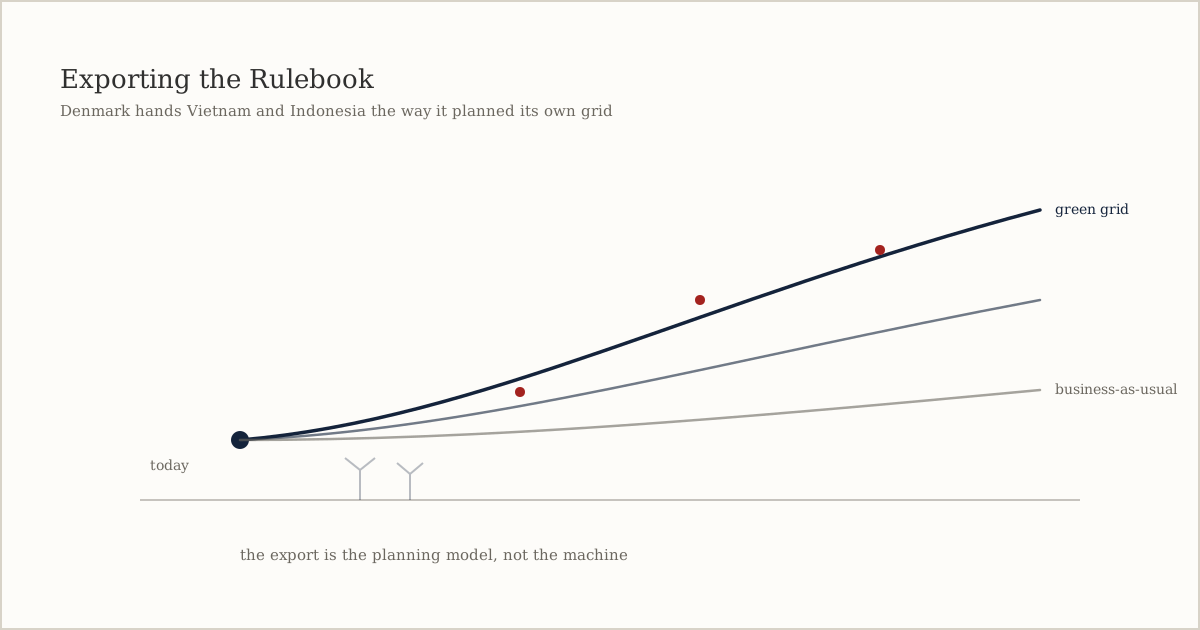
Denmark's most valuable green export to Asia is not a machine. It is a method — the long-term energy modeling and planning apparatus that a small, windy country used to rebuild its own power system, now being installed inside the energy ministries of Vietnam and Indonesia.
The vehicle is the Danish Energy Partnership Programme, a government-to-government arrangement that pairs Danish energy officials and technical agencies with their counterparts in emerging economies. In Vietnam, the partnership has run for years and produced the recurring Vietnam Energy Outlook reports — scenario studies that map how the country could decarbonize its grid — while a broader Green Strategic Partnership, agreed in 2023, set up inter-ministerial machinery to carry the work into policy. The current phase of the energy program was scheduled to conclude in March 2026, with a successor already in design. Indonesia is part of the same program.
This is capacity, not cash, and that is the point. Denmark is not trying to out-lend Japan or China in Southeast Asia; it does not have the balance sheet. What it has is a credible story about governance — how to model demand, integrate variable renewables, price power, and write the regulations that let wind and solar onto a grid without destabilizing it. For countries planning large energy transitions, that planning capability is a genuine bottleneck, and one that outlasts any single power plant.
Where governance meets the sales pitch
The uncomfortable adjacency is that Denmark's biggest companies sell exactly what these newly capable ministries will need to buy. Vestas builds turbines; Orsted develops offshore wind; Danish engineering and consulting firms design and certify projects. A grid code shaped by Danish advice, and a national energy plan built on Danish modeling, is not a guarantee of Danish contracts — but it is not a disadvantage to them either. The government's own framing places development cooperation and export promotion in the same sentence.
The Danish Energy Partnership Programme is part of Denmark's commitment to help emerging economies with their low-carbon transition — and, its design documents note, to advance Danish green solutions abroad.
That overlap does not void the benefit to the recipient. Vietnam's transition is real, its need for planning expertise is real, and the Energy Outlook reports have given Hanoi analytical tools it did not previously possess. The honest description is dual-purpose: aid that builds a partner's capacity and, in the same motion, familiarizes that partner with a Danish way of doing things that Danish firms are well placed to supply.
The claim to watch is the one in the headline version of this story — that Denmark is exporting green governance. Governance is harder to transfer than hardware. A modeling framework works only if the ministry can keep running it after the Danish advisers rotate out, if the regulations survive a change of government, and if the plans are actually implemented rather than shelved. Denmark has handed Vietnam and Indonesia a serviceable blueprint and the training to read it. Whether it becomes governance, rather than a well-produced report, is now a domestic question in Hanoi and Jakarta.