
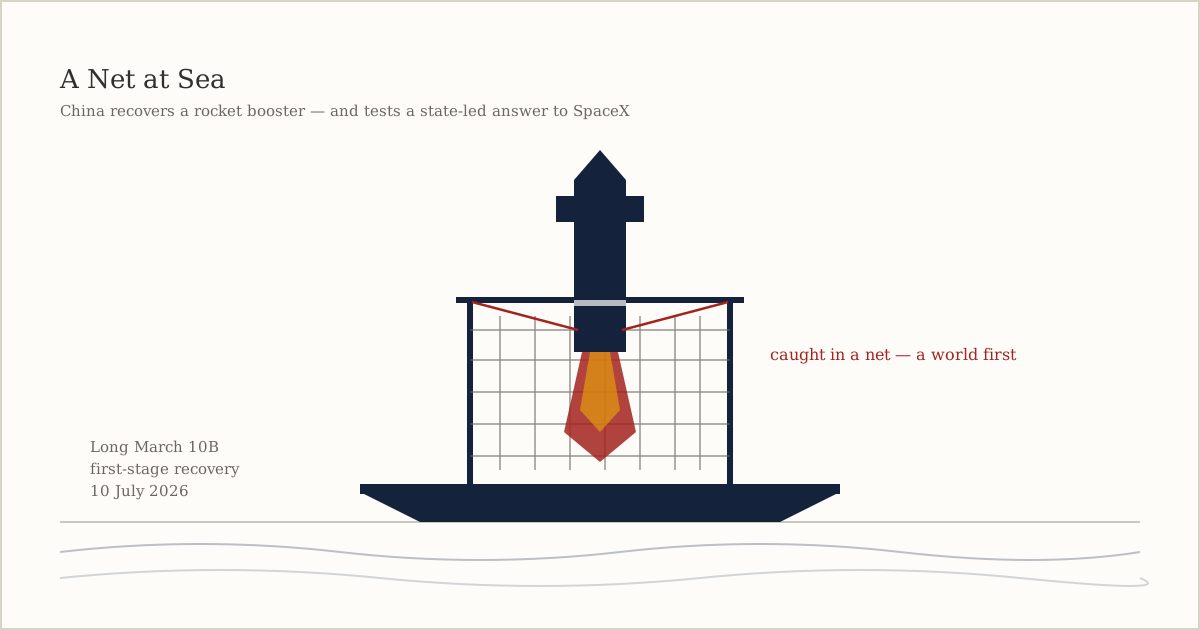
Six minutes after it separated from the rocket carrying its payload toward orbit, the booster came back down over the sea and did something no rocket had done before: it was caught in a net. On July 10, 2026, the first stage of China's Long March 10B descended toward a platform on a recovery ship, deployed a hook that snagged a set of tension cables, and settled into a mesh frame strung across the deck. The stage had flown for the first time that morning. It was already scheduled to fly again.
The catch was a genuine milestone, and an unusual one. It was China's first controlled recovery of an orbital-class first stage, the world's first net recovery of a booster, and — the detail that impressed engineers most — it happened on the vehicle's maiden flight, something even SpaceX did not manage. Built by the China Academy of Launch Vehicle Technology, an arm of the state-owned China Aerospace Science and Technology Corporation (CASC), the Long March 10B lifted off from Hainan at 12:15 a.m. and, by the reckoning of the people who track such things, made China only the second country ever to bring an orbital booster home intact.
Then the perspective. SpaceX stopped celebrating landings years ago. In 2025 it flew 165 orbital missions — close to one every other day, and nearly twice the launch total of China's entire space program — and some of its Falcon 9 boosters have flown more than 20 times each. The Long March 10B has landed one stage, once, and its reusable configuration lifts about 16 tons to low-Earth orbit against the Falcon 9's 22.8. Catching a rocket in a net proves the physics. Turning reuse into something routine, cheap and boring is a different and much longer project, and it is the one SpaceX has already finished.
Two ways to chase one company
What makes the Chinese effort worth watching is less the booster than the machine behind it. Beijing is not chasing SpaceX with a single champion. It is running what analysts have called a wolf-pack: CASC's state rockets, the state-developed Long March 12A, and a field of nominally commercial firms — LandSpace, Galactic Energy, iSpace, Deep Blue Aerospace, Space Epoch — most of them seeded, funded or steered by the state, all pointed at the same problem. LandSpace's methane-fueled Zhuque-3 and the Long March 12A both reached orbit in December and both failed to stick the landing; the Long March 10B succeeded. The logic of the model is that it does not matter much which one gets there first, because they are rowing in the same direction on the state's schedule.
The point of a wolf-pack is that no single firm can fail the mission. Its weakness is that no single firm has to win it.
That is the promise of coordination: redundancy, patient money, and a national target that does not move with a quarterly earnings call. It is also the model's limit. State programs are not known for the ruthless cost-cutting that made Falcon 9 cheap, and a structure built so that no one company can sink the effort is also one in which no company is forced to outrun the others. China's planners are trying to import the discipline of competition — several launch firms are preparing public listings, and LandSpace has floated prices below $3,000 a kilogram after reuse — without importing the dependence on any one of them.
The mirror image
The contrast with the United States is the part Beijing discusses least and studies most. America reached reusable rockets first by doing close to the opposite: it let one private company run far ahead of the field, and then leaned on it. NASA relies on SpaceX to carry its astronauts; the Pentagon relies on it to launch its satellites; a large share of the world's new orbital capacity, and the Starlink network overhead, belongs to a single firm controlled by a single person. That concentration is a chief reason the United States is years ahead. It is also a single point of dependence, and Chinese planners point to it, quietly, as the argument for spreading their own bets.
The prize underneath the engineering is the satellite economy. Cheap, reusable rockets are what let SpaceX blanket the sky with Starlink and sell connectivity from the Sahel to the South Pacific. A Chinese rocket that can fly, land and fly again at low cost is the precondition for the state's planned mega-constellations to compete for those same customers across Africa, the Middle East and Southeast Asia. The booster in the net is a means; the market in the sky is the end.
For now, China has done the hard, visible thing and not yet the harder, invisible one. CASC says it will fly the recovered stage again before the end of the year. A second flight, and then a tenth, is what will show whether the net catch was a demonstration or the first unit off a production line. The question the July launch actually posed is not whether China can copy SpaceX. It is whether a dozen state-directed companies aimed at one goal can do together what one company did alone — and whether the country that bet on the crowd, or the one that bet on the single firm, has chosen the more fragile way up.