
Even before the latest war between the United States and Iran pushed energy security back to the center of global politics, most Nepalis had already made up their minds about electric vehicles.
The country imports virtually all of its petroleum products through India. Decades of fuel shortages, repeated border disruptions, and the memory of the 2015 blockade convinced many Nepalis that transport powered by imported diesel and gasoline would always leave the country strategically vulnerable. Electricity, by contrast, comes increasingly from Nepal’s own rivers. Driving on hydropower is not simply cleaner; it is one of the few forms of energy independence available to a small, landlocked Himalayan state.
That thinking has transformed one of the world’s poorest countries into one of the world’s most enthusiastic adopters of electric vehicles.
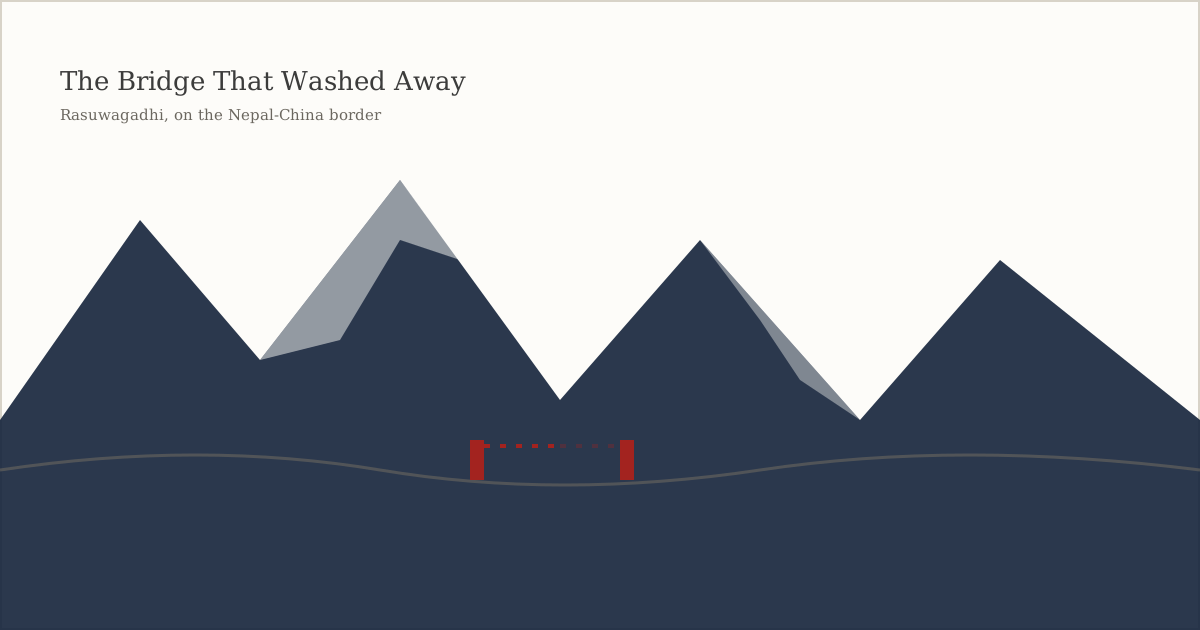
Electric vehicles made up roughly 73 percent of new passenger car sales in Nepal in 2025 — the second-highest EV market share of any country on earth, behind only Norway, in a country with a fraction of Norway's income per capita. Chinese brands, led by BYD, dominate that market. Almost all of them arrive the same way: through Rasuwagadhi, the single overland corridor that has carried more than 14,000 electric vehicles across the Himalayas over the past decade.
Nepal has the world's second-highest EV market share — built almost entirely on a single mountain road that a monsoon flood can close for the better part of a year.
The reasons the boom happened at all are mostly policy, not just proximity to Chinese factories. Nepal taxes the combustion-engine cars its middle class might otherwise buy at rates that can double or triple sticker price, while offering electric vehicles sharply reduced customs duty and excise — a deliberate bet, tied to the country's cheap and abundant hydropower, that EVs are both a climate policy and an industrial one. Chinese automakers, squeezed by overcapacity at home and tariff walls going up in the US and Europe, found in Nepal a price-sensitive market willing to buy whatever they could ship over a mountain pass. A country of 30 million people, most of them far from rich, now buys more of its new cars electric than almost anywhere else on the planet.
The flood is the other half of the story. With Rasuwagadhi impassable, EV imports fell roughly a quarter year-on-year in the months that followed, Nepal's customs data show, and broader vehicle imports fell with them as containers and dealers scrambled for alternatives. Traders have pushed cars through the Mustang route and the Korala border point instead. Both are longer, higher-altitude, and were never built for volume freight. The road that made the boom possible runs through one bridge and one valley prone to glacial-lake floods — which is now Nepal's biggest weakness in a market where it otherwise ranks second in the world.
Next to Thailand or Brazil, Nepal barely registers on a Chinese automaker's spreadsheet. But it's a preview. Aggressive pricing, government incentives doing the marketing for them, freight funneled through one choke point — the same playbook is running in smaller, equally flood-prone markets across South and Southeast Asia. Nepal shows both sides of the bet: how fast a Chinese EV can take over a country's car market, and how fast one washed-out bridge can put that takeover on hold.