
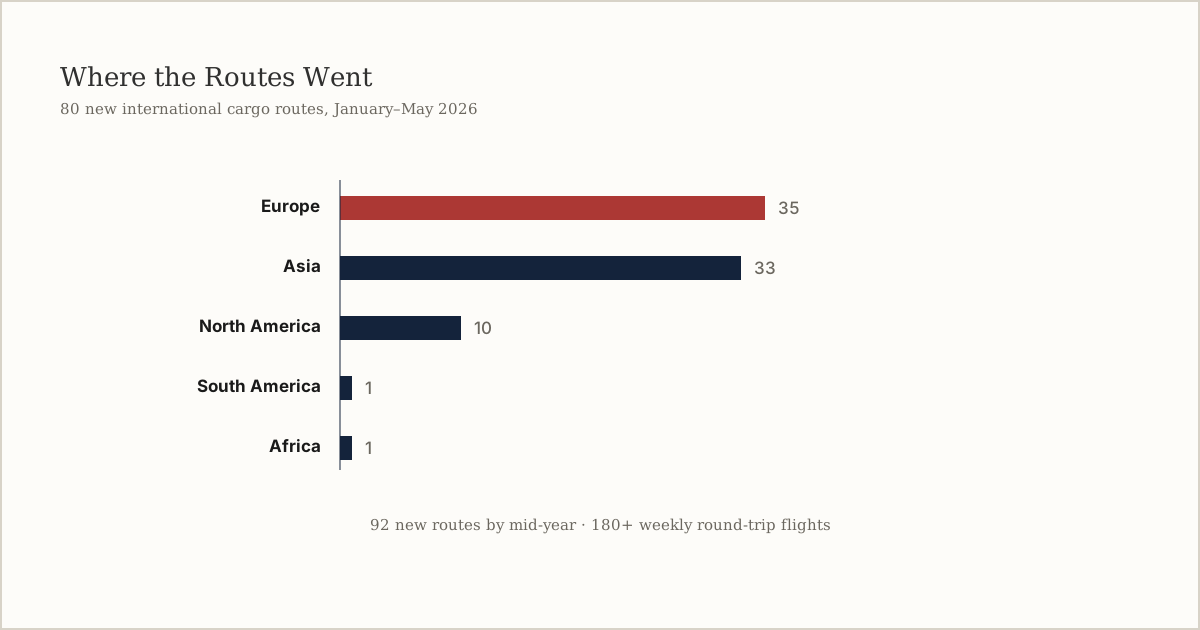
Take the first five months of 2026, when China opened 80 new international air cargo routes, and sort them by where they land. Thirty-five went to Europe. Thirty-three stayed inside Asia. Ten crossed to North America. One reached South America. One reached Africa. That distribution, not the total, is the story, because it is a near-perfect map of where the parcels are going.
By the end of June the count had risen to 92 new routes for the half-year, according to the Air Logistics Committee of the China Federation of Logistics and Purchasing. The additions came with real capacity behind them: more than 180 new weekly round-trip flights by late May, hauling a cargo mix that industry data describe as mostly cross-border e-commerce parcels, high-end manufactured goods and perishables—the categories that cannot wait for a ship.
The lopsided geography is the point. Europe and Asia together took roughly 85 percent of the new routes, which is exactly where a decade of cross-border online shopping has concentrated demand. The single lonely route to Africa and the single one to South America are not signs of neglect so much as evidence of what air freight is actually for: high-value, time-sensitive goods flowing to markets with the disposable income and the delivery expectations to justify the cost of putting cargo in the sky.
By the end of June the count had risen to 92 new routes for the half-year, according to the Air Logistics Committee of the China Federation of Logistics and Purchasing.
There is a resilience argument underneath the commercial one. Every new dedicated freight lane is a path that does not depend on the belly space of passenger jets or on the increasingly unreliable sea lanes through the Red Sea and the major straits. For an export economy that has spent two years watching shipping routes lengthen and insurance premiums climb, a denser air-freight web is a hedge—more expensive per kilo, but harder to choke off at a single chokepoint.
The limit is physics and money: planes will never move the tonnage that ships do, and air freight remains a sliver of total trade by weight. What it moves is the valuable, urgent sliver, and that sliver is where margins and headlines both live. Ninety-two new routes in six months is less a boast about volume than a bet about which goods will define the next phase of Chinese trade, and how fast they need to arrive.