
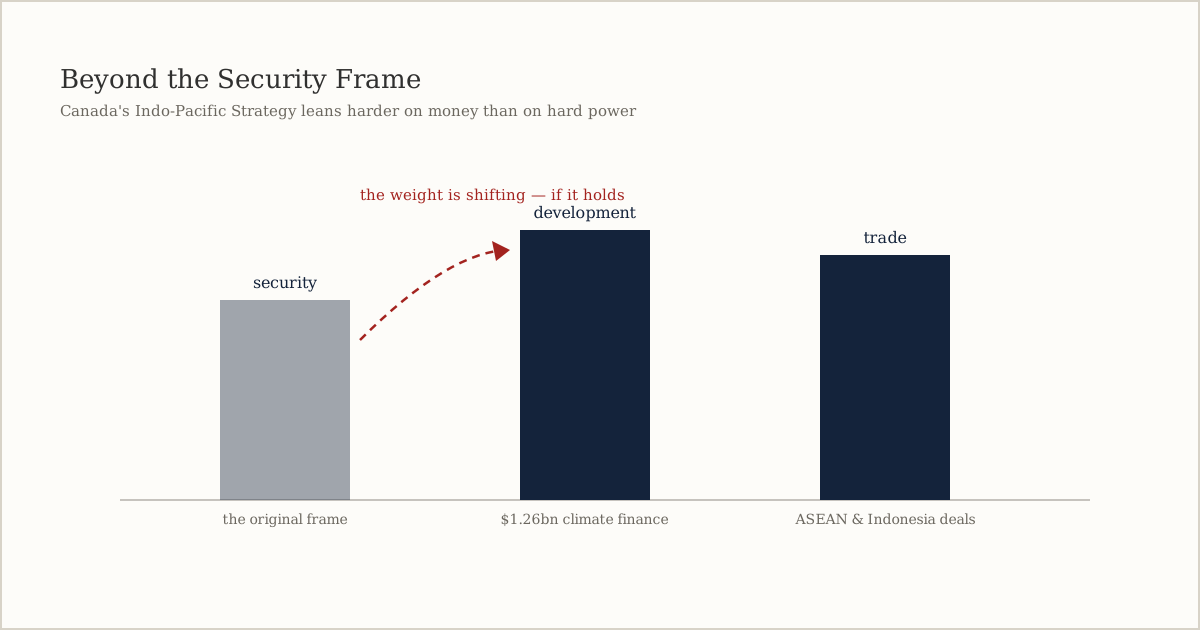
Canada launched its Indo-Pacific Strategy in November 2022 with the vocabulary of security — supply chains, deterrence, a region described as decisive for the next half century. Three years on, the harder-edged parts of the strategy have proved slower than the development and economic ones, and it is the money for climate, nature and trade that has actually moved.
The figures are specific. Canada has allocated about C$1.26 billion of its climate-finance commitment to the Indo-Pacific. In June 2024 it pledged up to C$350 million in concessional financing and up to C$10 million in technical assistance to the Asian Development Bank to set up the Canadian Climate and Nature Fund for the Private Sector in Asia, a vehicle meant to pull private capital into climate and nature projects. It has put the region at the front of the Powering Past Coal Alliance, and it is chasing commercial ground where Canadian firms can compete — transmission upgrades, distributed renewables, port decarbonization — in Indonesia, the Philippines and Vietnam. A trade agreement with Indonesia is signed; talks with the wider Association of Southeast Asian Nations (ASEAN) continue.
This is a real pivot from the security framing, and a sensible one for a country whose hard-power weight in Asia is modest. Canada cannot out-spend the United States, out-build China, or out-station either. What it can offer is a narrower menu: clean-technology expertise, concessional and blended finance, coal-to-clean transition support, and the softer goods — education, women's rights, food security, migration partnerships — that appear across the strategy's development pillar.
The distance problem
The difficulty is not the design but the follow-through. Ottawa is a long way from the region, its attention is easily pulled back across the Atlantic and to its southern border, and its aid budget competes with domestic pressures. Middle-power strategies live or die on consistency, and consistency is exactly what a distant government with shifting priorities finds hardest to sustain.
Canada will share expertise on natural disaster resilience and recovery and promote clean technology, the strategy says, prioritizing the Indo-Pacific in its coal-to-clean commitments.
Recipients have learned to read the gap between a launch and a disbursement. A fund announced in 2024 is judged by whether its money is deployed in 2026 and 2027, by whether the concessional financing actually crowds in private capital or simply sits as a headline, and by whether Canadian trade negotiators stay at the table when the domestic news cycle moves on. The Asia Pacific Foundation of Canada convened an Indo-Pacific Forum in Ottawa in October 2025 partly to press that point — to turn a strategy into a habit.
There is also the matter of scale. C$1.26 billion across a region this size, spread over years, is meaningful but not transformative, and Canadian climate finance lands alongside far larger flows from Japan, Australia, the multilateral banks and China. Canada's advantage, if it has one, is not volume. It is credibility in specific niches — clean tech, nature finance, the rule-bound reliability of a partner with no territorial stake in the region's disputes.
Whether that credibility compounds depends on the least glamorous variable in development policy: showing up again, and then again, after the ministers who announced the strategy have moved on. Canada has committed the money. The record it is building now is whether the money, and the attention, keep arriving.