
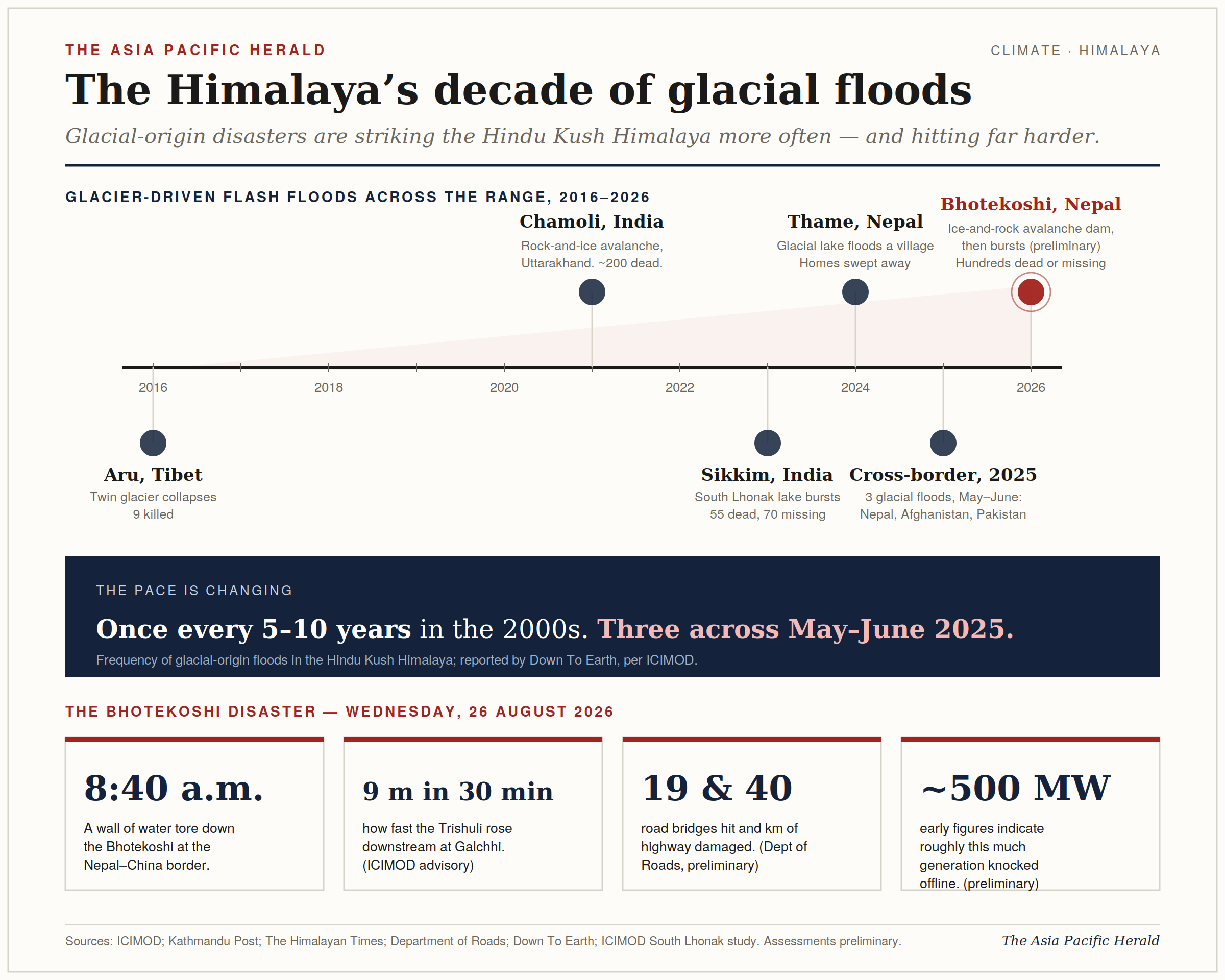
KATHMANDU—A sudden surge of water, mud and boulders swept down the Bhote Koshi and Trishuli river systems on Wednesday morning, destroying settlements, bridges, roads and hydropower facilities from the Nepal–China border into central Nepal. Nepal Police had confirmed 270 deaths as of 1:30 p.m. Thursday, according to Setopati. Hundreds more remained unaccounted for.
Water levels in the Bhote Koshi basin began rising at about 9 a.m., according to an ICIMOD advisory. The Trishuli rose by as much as nine metres in 30 minutes at Galchhi and seven metres at Malekhu. Monitoring stations were damaged or swept away, while helicopters were used to reach communities cut off by destroyed roads.
Television crews that flew over the area showed towns and settlements buried in debris—places that only hours earlier had been busy with trekkers, tourists and local businesses. Before-and-after images showed the scale of the destruction.
Rescue was nearly impossible from the ground. Helicopters lifted injured people out of a canyon where the road no longer existed, and the crossing that handles much of Nepal’s overland trade with China had ceased to function. Casualties were reported on the Chinese side of the border as well.
Initial satellite and field assessments point to an ice-and-rock avalanche entering the Lhende Khola, a tributary of the Bhote Koshi, and possibly creating a temporary natural dam before water and debris surged downstream. ICIMOD says the trigger remains unconfirmed and that investigators are analysing hydrological, seismic and remote-sensing data.
Rijan Bhakta Kayastha, a climate researcher and professor at Kathmandu University, told the Kathmandu Post that an avalanche appeared to have blocked the Lhende before the flood broke through. He said scientists had not established whether a seismic signal recorded around the same time contributed to the collapse. Early reports described the signal as a magnitude-4.4 earthquake; USGS later reclassified it as a magnitude-5.2 glacial-collapse event. The earlier earthquake description should no longer be used as evidence of a possible trigger.
This distinction is not trivial. A glacial-lake outburst, an ice-rock avalanche and the failure of a short-lived debris dam can produce similar downstream devastation but are not the same process. The 2026 event’s precise sequence has not yet been established.
The flood followed another sudden surge in the same river system in July 2025. Scientists attributed that earlier event to the rapid drainage of a supraglacial lake. Across the Hindu Kush Himalaya, ICIMOD recorded three glacial-origin floods during May and June 2025—in Nepal’s Limi Valley, Afghanistan’s Andarab Valley and the Chitral–Hunza area of Pakistan—after such events had previously been expected roughly once every five to ten years, as summarized by Down To Earth. These are regional observations, not a formal attribution of Wednesday’s flood to climate change.
Warming nevertheless changes the background conditions. Glaciers are retreating, permafrost is thawing and steep rock-and-ice slopes are becoming less stable. Farooq Azam of ICIMOD and Simon Cox of Earth Sciences New Zealand described those mechanisms to Reuters. ICIMOD cautioned that it was too early to determine how much climate change contributed to this particular event.
Other Himalayan disasters show how hazards can cascade. In October 2023, the collapse of frozen moraine into South Lhonak Lake in Sikkim generated a wave that breached the lake’s dam and devastated the Teesta valley. A peer-reviewed analysis summarized by ICIMOD found that an unstable moraine section had been moving by more than 15 metres a year; the disaster killed 55 people and left 70 missing.
The exposure is also economic. Hydropower plants, roads, border facilities and settlements occupy narrow valleys because that is where rivers and trade routes run. Preliminary reporting put the damage at 19 motorable bridges and nearly 40 kilometres of road. Early estimates put affected generating capacity at more than 430 megawatts.
The immediate risk has not ended. ICIMOD said river blockages and downstream hazards were still being assessed.
Reader information: See this Kathmandu Post guide for ways to help Nepal’s flood-affected communities.