
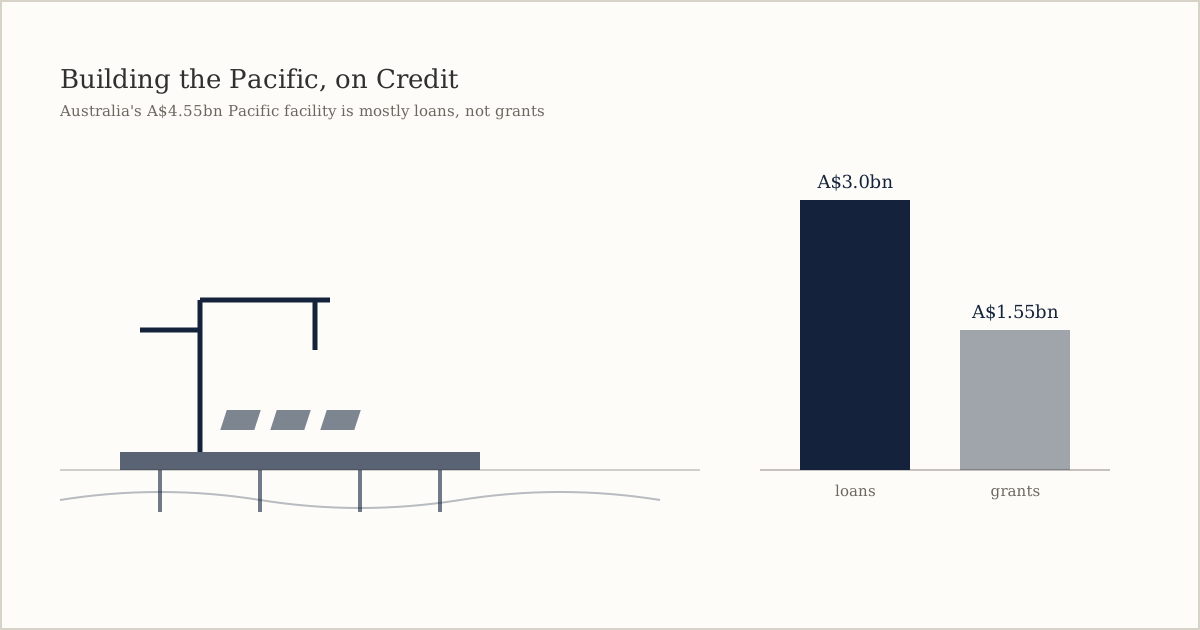
Of the A$4.55 billion Australia has now put behind its flagship Pacific infrastructure vehicle, A$3 billion is a loan cap and A$1.55 billion is grant money. That ratio is the story the ribbon-cuttings tend to skip.
In January 2026, Foreign Minister Penny Wong used a meeting of the Pacific Islands Forum Troika to announce fresh funding for the Australian Infrastructure Financing Facility for the Pacific (AIFFP), lifting its total to A$4.55 billion. The facility bankrolls the physical scaffolding of small Pacific economies — ports, undersea cables, roads, power — and pairs it with a A$350 million Pacific Climate Infrastructure Financing Partnership aimed at renewable energy and climate resilience. By the government's own count, AIFFP projects have created close to 700 jobs and put local firms to work on construction and delivery.
Those are concrete gains for economies where a single reliable wharf or transmission line can change what is possible. The facility also does something recipients have long asked of donors: it builds things, rather than funding another workshop. But the structure carries a question. Most of the money is lent, not given, and Pacific states already carry debt loads that leave little room for more. A loan for a climate-resilient port is still a loan, repayable by a government whose revenue base is thin and whose coastline is the thing most at risk.
The contest under the concrete
The headline ambition — to build the Pacific's infrastructure — is inseparable from who else is offering to build it. Australia stood up the AIFFP in 2019, the year after China's lending across the region drew Canberra's attention, and the facility has always been as much an instrument of strategic positioning as of development. Officials rarely say so in those terms. The timing, the geography, and the emphasis on being the region's partner of choice say it for them.
That does not make the projects less useful to the countries receiving them. It does mean the Pacific is being courted, and courted states can extract better terms. Several island governments have pushed Canberra to weight the facility toward grants and toward the climate adaptation they rank as their first security threat, rather than the ports and cables that serve a wider strategic map.
The AIFFP integrates climate considerations across the feasibility, design and construction of its investments, the facility says, to increase their resilience.
Labor is the other half of the relationship, and the one that touches ordinary households most directly. Through the separate Pacific Australia Labour Mobility scheme, tens of thousands of Pacific workers fill seasonal and longer-term jobs in Australia and send remittances home — money that in some economies rivals aid as a share of income. The scheme has been criticized for the strain it puts on families and small island workforces when skilled workers leave. It has also become one of the most tangible benefits of the relationship, and one Pacific governments guard.
What counts as success
Judged as geopolitics, the facility is doing its job: Australia is visibly present, building, and lending across a region it does not want to cede. Judged as development, the test is narrower and slower. It is whether the ports raise trade, whether the grids stay on, whether the loans are serviceable, and whether the climate money reaches the adaptation that Pacific leaders — not Canberra — have identified as the priority. The A$1.55 billion in grants will be spent quickly. The A$3 billion in loans will be repaid over decades, by the same governments now deciding whose infrastructure they would rather owe.