
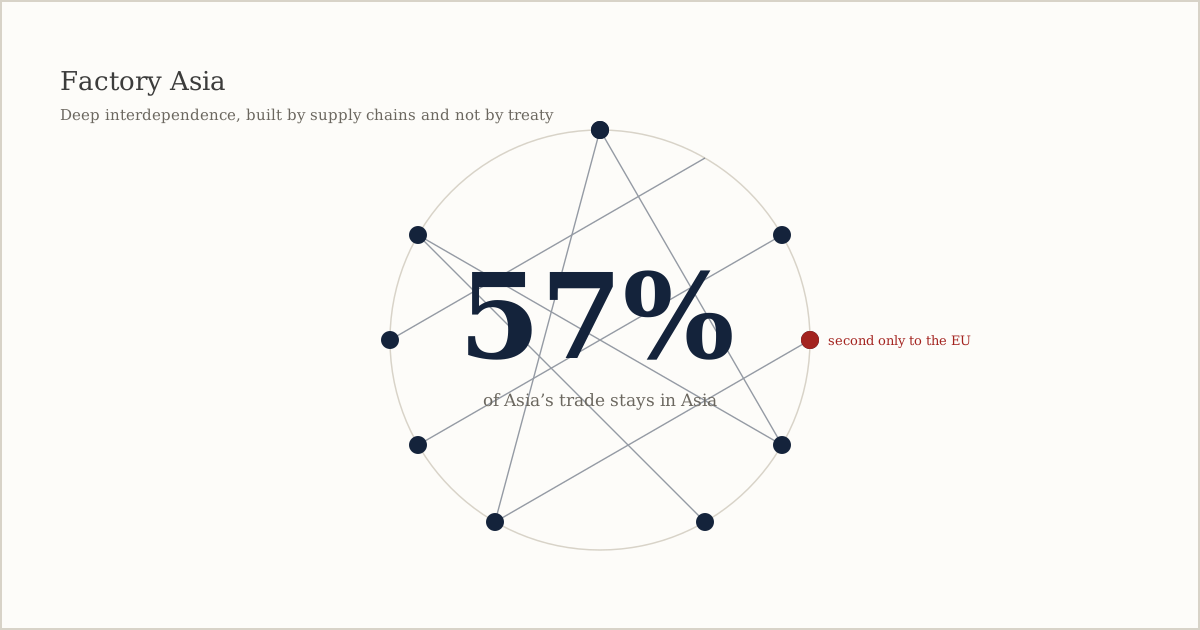
Nearly three of every five dollars of Asian trade stay inside Asia. The Asian Development Bank puts the region's intraregional trade share at close to 57 per cent, a band it has held for more than a decade and a record 57.3 per cent in 2016. Only the European Union, a single market with a shared external tariff, trades with itself more intensively. On that one number, Asia looks like the most integrated economic space in the developing world.
It is not. The European Union built its 60-odd per cent on a treaty: one market, one border regime, a court, a parliament, for most members a currency. Asia built its 57 per cent on factories. The bulk of what crosses Asian borders is not finished goods moving to consumers but components moving between plants: chips, display panels, battery precursors, auto parts, the intermediate inputs of what economists call Factory Asia. The integration is real, deep and, so far, almost entirely corporate. The politics never caught up to the supply chain.
The number, and how it was built
Asia's interdependence was assembled one production stage at a time. A design in Japan or Korea, a chip fabricated in Taiwan, a component made in Malaysia, final assembly in Vietnam or China, all before a phone or a car reaches a buyer anywhere. That cross-border choreography is why intermediate goods, not consumer goods, dominate intra-Asian flows, and why the trade share held up even as the region's export destinations shifted.
Asia built its 57 per cent on factories, not a treaty. The politics never caught up to the supply chain.
A lattice, not a union
The Regional Comprehensive Economic Partnership, in force since January 2022, is the closest thing the region has to a grand bargain: roughly 30 per cent of the world's people and more than a third of global output under one agreement, and the first to seat China, Japan and Korea at the same table, three economies that are nearly 80 per cent of RCEP's GDP and had never before shared a trade pact. But RCEP mostly harmonises tariffs that were already low; it did not create a single market, and in its early years the three big East Asian economies actually traded slightly less with each other, not more. Alongside it runs the higher-standard CPTPP and a web of older ASEAN-plus-one deals. The result is overlap, not union: a region stitched by many bilateral and plurilateral threads rather than one constitutional seam.
For all the acronyms, the tariffs were already low. Some 20 per cent of ASEAN's trade is with its own members and another 30 per cent with the four non-ASEAN RCEP economies, most of it under duties that were near zero before RCEP was signed. The agreements ratify the map that the factories had already drawn.
Where the integration runs thin
The 57 per cent is a regional average hiding a sharp east-west gradient. Southeast and East Asia are the most integrated subregions on earth outside Europe; South and Central Asia are among the least. Intra-South-Asian trade is stuck in the low single digits of the subregion's total, a casualty of the frozen India-Pakistan relationship and a moribund SAARC. The Pacific island economies, small and distant, sit further out still. When the Herald writes about “Asian integration,” it is largely describing an arc from Tokyo and Seoul through the Chinese coast to Singapore and Jakarta. The subcontinent and the islands are in the masthead but not, yet, in the supply chain.
The 2025 stress test
The tariff turbulence of 2025 was the first real test of whether interdependence buys resilience. It largely did. As shipments to the United States fell for some economies, the region rerouted: Asia-Pacific export growth to partners inside the region ran at 12.4 per cent in 2025, well above growth to the US, Europe or the Americas, according to the ADB. Investment told a similar story. Global foreign direct investment into the region dipped about 2 per cent to $614 billion in 2024, but intraregional investment held firm and digital FDI, the data centres and AI infrastructure and fintech, kept climbing to roughly 35 per cent of inflows. The plumbing bent and did not break.
That resilience is also the exposure. The same production networks that reroute trade also concentrate it: economies deep in Factory Asia depend on foreign inputs they do not control, which is precisely what a blockade, a chip embargo or a shipping-lane disruption would sever. Interdependence is a shock absorber until the shock lands on a node everyone shares.
The gap that the number hides
The distance between the 57 per cent and the missing union is the real subject. Asia has assembled the interdependence of a single economy while keeping the sovereignty of fifty separate ones, and that arrangement held only as long as the open global trading order held the ring for it. When Washington raised tariffs in 2025, the region could reroute its factories but could not answer with one voice; each government went to Washington alone. China, Japan and Korea have been negotiating a trilateral trade agreement, on and off, since 2012. They have signed nothing.