
In Islamabad, the government shortened the working week to four days and told civil servants to log in from home — to burn less diesel, not to slow a virus. In Colombo, fuel rationing returned for the first time since Sri Lanka's 2022 default. In Manila, the president signed an emergency decree. The cause is the same in each case, and it is not domestic.
On July 14, 2026, the Asian Development Bank (ADB) reworked part of its crisis machinery in response. Its board of directors approved changes to three existing instruments — the Countercyclical Support Facility, Contingent Disaster Financing, and the Emergency Assistance Loan — so that all three now explicitly cover energy-supply and food-price shocks, not only the recessions and natural disasters they were built for. The bank says the aim is to move budget support to a stressed government faster and better.
What the board did not do is attach new money. The announcement widens what the existing instruments can be used for; it does not add capital to them, and it names no figure. Its value, if it has one, is procedural — a government facing a fuel-price emergency can now ask an established facility for help without waiting for a bespoke loan to be designed from scratch. Whether that turns out to be fast in practice, rather than fast on paper, is the part the reforms cannot guarantee.
"Ongoing instability from the Middle East conflict is putting pressure on governments and people across the region, raising fuel bills, food prices, borrowing costs," said ADB President Masato Kanda, in a statement issued on the day of the announcement. "ADB is moving quickly, before shocks become deeper crises. These tools will deliver support faster, give governments more room to act, and keep the focus where it belongs: protecting people, preserving stability, and building stronger energy and food systems."
Six months and one strait
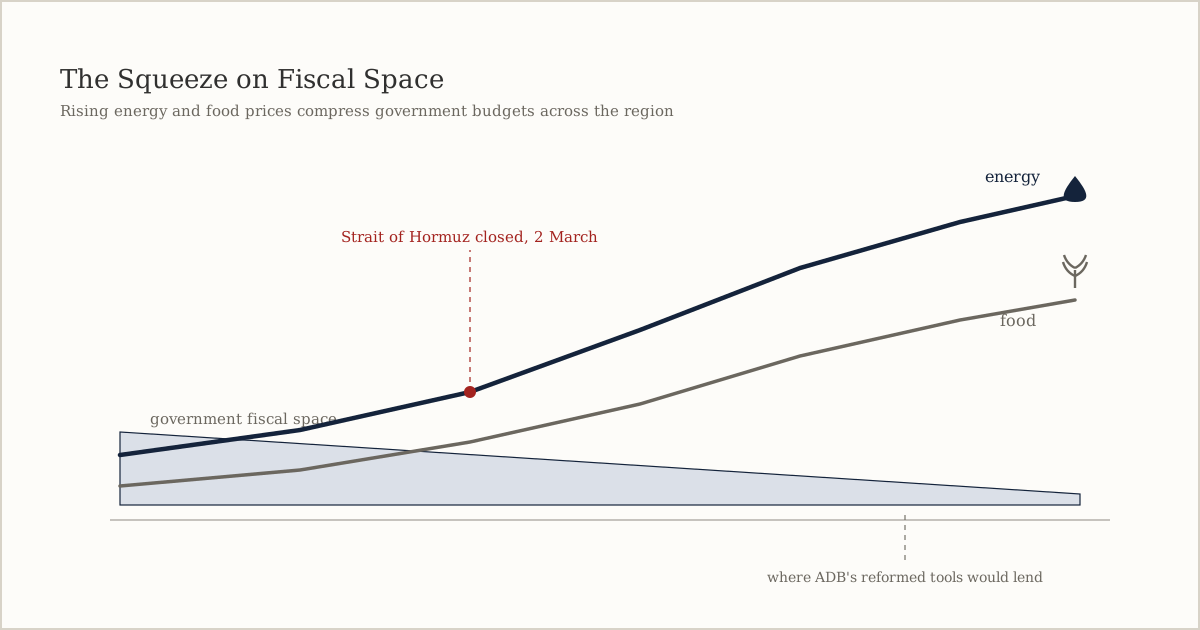
The strait is Hormuz. When Iran moved to close it on 2 March 2026, it choked a channel through which roughly a fifth of the world's oil and a large share of its liquefied natural gas passes. In 2024, about 84 percent of the crude and 83 percent of the gas that transited Hormuz was bound for Asian buyers; close to 70 percent of the oil went to four countries — China, India, Japan and South Korea.
The International Energy Agency called it the largest supply disruption in the history of the global oil market.
Prices rose. Brent crude jumped to the low $80s within days of the closure and, by the end of March, had posted its steepest monthly rise on record, up roughly 65 percent from where it began the year. It has since eased back toward $70 as buyers rerouted cargoes around the Cape of Good Hope — 15 to 20 extra days at sea, and about three times the pre-crisis rate to hire a supertanker. Forecasters still expect Brent to average around $86 a barrel across 2026, against $69 in 2025.
The pressure has spread beyond the pump. In its July 2026 outlook, the ADB raised its inflation forecast for developing Asia and the Pacific to 4.3 percent this year, from 3 percent in 2025, and cut its growth forecast to 4.9 percent, down from 5.5 percent in 2025. South Asia takes the hardest hit, with inflation projected to climb from 2.9 to 5.0 percent; in developing Southeast Asia the forecast rises from 2.3 to 3.2 percent. The bank expects regional inflation to ease to 3.4 percent in 2027. Its economists describe the mechanism plainly: an energy shock that keeps broadening into everything energy touches — fertilizer, freight, food.
A third shock on empty buffers
The shock lands on economies with little cushion left. The region spent the decade absorbing blows in sequence — the pandemic that shuttered economies and inflated public debt from 2020, then the 2022 war in Ukraine that sent wheat, fertilizer and energy prices vertical. Many governments never rebuilt the fiscal buffers those years drained. The 2026 shock arrives on top of the borrowing left behind.
The responses show the strain. Pakistan's oil import bill climbed from about $300 million before the conflict to $800 million, Prime Minister Shehbaz Sharif said; the government turned to conservation — the four-day week, school closures, remote work — while its finance minister, Muhammad Aurangzeb, tried to calm nerves. "We are not going for rationing of fuel as there is no fuel shortage in the country, but things could become serious if the war drags on," he told reporters, as reported by Dawn. Sri Lanka, where petroleum is about a quarter of all imports, revived crisis-era rationing and struck a deal for Russian crude. Indonesia and Malaysia held fuel prices down with subsidies and capped how much any driver could buy from 1 April. In the Philippines, President Ferdinand Marcos Jr. declared a state of national energy emergency, citing in his executive order an "imminent danger of a critically low energy supply."
Each of those measures costs money the treasury had not budgeted. The reformed tools are meant to help cover it. Under the changes, the Countercyclical Support Facility can provide budget support to a member under severe stress from high prices, shortages or import disruptions — money the bank says can fund social protection, keep public services running, or shore up energy and food security. It comes with a condition: the government must maintain sound macroeconomic management and debt sustainability. That requirement is prudent, and it also cuts against the tool's purpose, because the governments in the deepest fiscal trouble — the ones a price shock hits hardest — are the least likely to clear the bar. Contingent Disaster Financing, which pre-arranges money that can be drawn down once agreed conditions are met, now extends to energy and food emergencies. The Emergency Assistance Loan, once reserved for disasters that flattened infrastructure, will release funds when the damage is to livelihoods and basic services rather than to roads and bridges.
The reforms change what the bank can lend for, and possibly how quickly. They do not change the price of oil, which is set in the Strait of Hormuz and not in Manila, and they add no new money to the region's response. The governments with the least fiscal space and the largest fuel-import bills — among them Pakistan, Sri Lanka and Bangladesh, which regional analysts have flagged as the hardest hit — are the ones the tools are meant for, and, because of the conditions attached, the ones that may find them hardest to use.